What part will you play today?

What “𝐩𝐚𝐫𝐭” will you play today?

Every day – I make commitments to myself, my family members, my friends, my work clients and to voluntary opportunities that I love to serve in.

For example, yesterday I had a key “𝐩𝐚𝐫𝐭” to play as the facilitator in a global virtual workshop, with 129 participants. I turned up at 6.00am (GMT), ready to guide each participant through the experience. Shortly afterwards my heart leapt when I received this lovely comment – “I must say today’s session was one of the best ever with such a spontaneous audience and so many volunteers! Thank you as always for making it so engaging and delivering it with such high energy!”

I loved playing my “𝐩𝐚𝐫𝐭” in the whole experience.

Yesterday, I was also thrilled to play my 𝐩𝐚𝐫𝐭 as a husband, a father, a son, a brother, a coach, a friend, a servant and a leader.

Wherever you are, whatever you choose to do with your life, may I invite you to consider this phrase quoted so frequently by David O. McKay – “What e’er thou art, act well thy 𝐩𝐚𝐫𝐭”.

Acting your part well simply means that wherever you are and whatever you are doing, you choose to do it to the best of your ability and to be as useful as you possibly can.

How will you choose to play your “𝐩𝐚𝐫𝐭” today?

Determination

And then it changed.

In our virtual session, all of the participants were viewing images representing different experiences or emotions connected with 𝐫𝐞𝐬𝐢𝐥𝐢𝐞𝐧𝐜𝐞. Each participant was to select an image that really resonated with them personally.

I asked the session producer to select one of the many images and asked participants to identify themselves if they had selected that specific image. The producer randomly chose one of those participants… and then it began.

The image chosen – 𝐝𝐞𝐭𝐞𝐫𝐦𝐢𝐧𝐚𝐭𝐢𝐨𝐧.

I asked the participant why this image resonated with her. She then shared a portion of her life story that had been filled with adversity, physical challenge and major setbacks. Yet there was a determination not to let those setbacks get in the way of her own ambitions. In that moment, we all listened intently, in wonder and awe – each of us touched by her emotional testimony. I’ve tried hard to imagine what her life may have been like.

No matter whatever life had thrown at her, she chose to carry on enjoying the challenge of life with optimism, a positive outlook and a gritty determination.

Resilience is a choice, we can all develop much more.

What is your reaction in the face of adversity?

Does 9.00 am exist?

“Does 9.00 am exist” I asked the delegates on the virtual time management workshop. Unanimously they responded “yes!” followed by a few whispers and puzzled faces.

As we explored the concept of time together, everyone soon realised that 9.00 am, along with 24 hours, 1,440 minutes and indeed 86,400 seconds were all simply something that mankind had created to manage time better – the study of horology is fascinating! We concluded – 9.00 am isn’t real! In fact the only thing that is real, is day & night, along with the seasons – spring, summer, autumn and winter.

Each of us are stewards of our time here upon earth. Each and every day counts.

Henry B. Eyring captured it well when he said – “Someday, when you know who you really are, you will be sorry you didn’t use your time better.”

I love these words penned by Robert Baird:

Time flies on wings of lightning;
We cannot call it back.
It comes, then passes forward
Along its onward track.
And if we are not mindful,
The chance will fade away,
For life is quick in passing.
’Tis as a single day.

Consider these questions focused on different time frames…

Are you doing everything that you should be doing with your one precious life?

How will you choose to fill the blank pages of your book of life today?

Optimism

Life constantly sends us challenges to test our positivity, and to be able to look towards the future with optimism, in spite of such difficulties isn’t always easy.
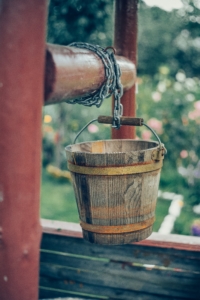
Recently I was reminded of the story of the two buckets that went down the well; as the one came up it said, “This is surely a cold and dreary world. No matter how many times I come up full, I always go down empty.” Then the other bucket laughed and said, “With me it is different. No matter how many times I go down empty, I always come up full.”
Much of life is dependent upon your attitude and how you respond to situations. Our attitude makes all the difference.
“Remember, a good attitude produces good results, a fair attitude fair results, a poor attitude poor results. We each shape our own life, and the shape of it is determined largely by our attitude.”
M. Russell Ballard
In the ups and downs of life – what attitude will you choose today?

Accountability 1984!

Yes – that’s me, I was 19.

It was November 1984 and I was in my first leadership role, working in Luton, England. Every month our team would meet together and the principle of accountability was front and centre.  We held each other responsible for the success and failures of the month gone by. As an extremely young and enthusiastic team leader, I decided that I’d spice up the accountability reports! Not only did I hire an American Footballers costume, but I adopted the hype and persona of a typical player! Yes, hard to believe that mild mannered old me, has an extrovert crazy streak running through me (thanks dad!). Subsequently, I recall (and my journal entries confirm) that the monthly reporting session was a tremendous success, even although the numbers and KPI’s themselves weren’t the best!

Our Actions

Through many experiences over numerous years and in a multitude of leadership roles I’ve served in since then, I’ve learned all too well, that “It is not only what we do, but also what we do not do, for which we are accountable.” Moliere.  Actions or lack of action even, almost always have consequences.

The dictionary defines accountability as: “Someone who is accountable is completely responsible for what they do and must be able to give a satisfactory reason for it.” Accountability then has to do with one’s exercising his own will in making decisions and following a course of conduct. It implies self-initiative and a measure of self-reliance. But it requires more than the ability to act for oneself. It must be guided by a knowledge of true principles.

In my home, family, community and business life, I have learned that true principles of accountability, are essential for success. So, what are these guiding principles of accountability?

Take Ownership.

  • No matter whether you succeed or fail, it is much, much better to take ownership of the responsibilities given to you. Simply stated, people want to know who is responsible for certain actions and who is accountable for the consequences of these actions. I’ve failed on numerous occasions, but I can also choose to pick myself up, dust myself down and get on with starting over.

Build Trust. 

  • Little by little, day by day, follow up on actions, be responsible, live your personal values and do what you say you are going to do.

Be Honest. 

We live in the most difficult of times and also the most amazing of times. It is absolutely critical to be truthful, honest, moral and ethical in all of your dealings at home, at work and in the community. To be anything different will cause you grief, heartache, misery, pain, leading ultimately to failure and despair.

Have Fun. 

  • No matter how difficult the challenges may become (and oftentimes they will), carry with you a sense of humour that will allow you to see the bright side of things even on the darkest of days.

Be Humble. 

  • In a recent article Humility vs Pride I suggested that “Humility is selfless not selfish. In fact I believe that humility is being authentic without any pretence or arrogance. It is really about being true to yourself and knowing your limitations, from the inside out.”  see – https://darylwatson.org/2019/05/13/leadership-essentials-humility-vs-pride/  I believe that a humility builds loyalty and responsibility.

Take Time. 

  • The most effective accountability moments are held one by one. Whether that is with your children in a personal interview, or with your boss or a subordinate in an important conversation. Be aware of the importance of taking time to do that. In Paterson etal’s “Crucial Conversations” there are numerous tips and ideas about how to make the most of those critical accountability moments.

My early attempts at motivational accountability in 1984, taught me valuable lessons about being present, in the moment and having some fun at the same time. Throughout the ensuing years, I’ve had to sit through some pretty tedious accountability interviews and meetings, some of my own doing too (thankfully only a few!)

I’ve found that consistently following these simple guiding principles will build great relationships over the long term.  In closing remember this quote from Thomas S. Monson; “When performance is measured, performance improves. When performance is measured and reported back, the rate of improvement accelerates!”

A big stick!

You’re safe, I’m not going to hit you with this big stick!

Do you remember the Stephen Covey quote “When you pick up one end of the stick, you pick up the other.”

Many years ago, whilst walking home with our golden Labrador Shane, he found a big stick and was determined to carry it all the way home.  A fence with a narrow opening became a massive problem for Shane.  Carrying the stick, no matter how hard he tried, he couldn’t get through, as the stick was longer than the narrow opening in the fence.  Several attempts at manoeuvring his head and his body in different directions, proved unsuccessful – he couldn’t do it.  Eventually, I took the stick from his mouth, carried it through the fence and gave it back to him on the other side.

I have never forgotten that experience with Shane.  I remember watching him try over and over again.  It was only when I intervened, was the obstacle overcome.

So it is with all of our choices in life.

We are free to choose our actions – “you pick up one end of the stick” but if we think that those choices are simply isolated to us alone – we are mistaken “you [also] pick up the other [end of the stick]”.

Both ends of the stick came with Shane that day.  The consequences quickly followed.

What are the consequences of whatever “stick” you choose to action and pick up today?

Under pressure?

When under 𝐩𝐫𝐞𝐬𝐬𝐮𝐫𝐞, I think I am a little strange, I seem to actually enjoy it! Is there something weird going on in my head?

Everyone has to deal with pressure, personally and professionally. Recently I have witnessed a surge in my workload. New clients bring their hopes, expectations and demands all at the same time! And yet, I actually love it! Maybe I am just downright weird?! Admittedly, as the years are passing by, I do get a little more tired and I am prone to nod off every now and again!

Over the years, I’ve learned a few lessons about dealing with pressure. I’d like to share my top tips.

– Have fun, be creative and take control.
– The imagined catastrophe in your head – never happens!
– Break tasks down and focus on one thing at a time.
– Slow down.
– Simplify, simplify, oh and yes – simplify!

Lastly, look after yourself. Spend time with family and friends, eat fresh healthy food (most of the time!), drink lots of water, sleep, take breaks, set aside time for exercise, go for walks and breathe the fresh air. Be spontaneous!

Like you, I am still learning, the key is to enjoy the journey and find happiness along the way.

Look out for the pressure rising again, just remember who you are and take control!

Simplify

Slowly, …in fact very slowly, I’m beginning to learn that small and simple is much better than big and complex.

Lots of virtual facilitation recently has reminded me of the following…

𝐒𝐢𝐦𝐩𝐥𝐢𝐟𝐲𝐢𝐧𝐠 𝐢𝐬 𝐩𝐨𝐰𝐞𝐫𝐟𝐮𝐥.

We must eliminate the unnecessary. It cuts through the noise. Great results follow.

When simplifying – consider these five questions…
1. Will it matter in 10 years?
2. What do I need more of in my life?
3. What do I need less of?
4. Is it essential?
5. How can I make this simpler?

By answering these questions regularly and honestly a new ability, perhaps a skill even – of being able to say no, deciding not to do something, being able to identify the things that are really worth doing and conversely the things that really aren’t worth doing at all – will start to shine through. Things become much simpler, clearer and understandable.

Why not start today and ask yourself the questions!

Eat Cake

How do you cope with failure? Coping with failure and disappointment are never easy…

Like you, I’ve had my fair share.

Early in my career, I was in charge of a major event that ended up being an absolute disaster. It was just awful, embarrassing, ending up with an extremely upset client.

I recall returning home late that evening considering what I should do next. Our team’s efforts had fallen woefully short of client expectations.

After wallowing in the mire for a few hours and dealing with the personal disappointment – to make me feel better, I turned to some comfort food for immediate relief! I ate cake!….For a brief moment it helped the negative emotions.

On quiet reflection I thought – “What the heck – we can do better than this”.

Key for me in that one experience included learning not to take the disaster personally, letting go of the immediate emotional baggage that arose, reflect and consider on the why of the failure, accept it, then move on.

I recall I visited the client the next day, apologised profusely, agreed some financial compensation – then moved on. Over the years though, I must confess to having eaten a few of those cakes! What have you learned from failure?

Eaten much cake lately!?

Lessons in Leadership

Being appointed to lead an organisation brings with it a host of feelings – ranging from excitement, to sheer terror!

I recall one appointment many years ago and during the first few days thinking to myself “Have they got the right person here? – just what can I do?!” Several weeks into the new role, as I was considering the future of the organisation, a rather unusual image of conflict and war kept coming into my mind. I scoured the internet for as close an image to what I had in my mind’s eye and eventually settled on this picture “The Periscope in the Trenches”.

I have reflected upon this image on many occasions and time and time again it has taught me so many insightful lessons. There will be yet more said on the start and end of the Great War.  Conflict is a daily occurrence in the world, whether it be Israel, Syria, Iraq, Lebanon, Ukraine or elsewhere – it is inescapable.

This image however of conflict and its application in the leadership world is a powerful one – let me explain.

  1. Periscopes

    What do these simple and yet powerful tools actually do? “A periscope is an instrument for observation over, around or through an object, obstacle or condition that prevents direct line-of-sight observation from an observer’s current position. In its simplest form, it consists of an outer case with mirrors at each end set parallel to each other at a 45-degree angle. This form of periscope, with the addition of two simple lenses, served for observation purposes in the trenches during World War 1″ (Wikipedia). From a position of safety, in this image, the periscope allows the soldier to see things at a different height level or in other words raises the vision of the soldier to view the atrocities of the battlefield above him. Over the years, I’ve discovered many tools to use as periscopes, to lift, inspire and raise the vision of others. Invitation #1, consider, or discuss with colleagues, what is the instrument or tool that will raise your organisation’s vision?

  2. Check in Often

    In order to assure his own and his company’s safety, the soldier had to regularly observe through his periscope the conditions that were prevailing above on no man’s land. In essence, frequently checking in on the activities on the battlefield enabled him to call for the correct actions to pursue. And so, it is as we establish the vision for any organisation, we must frequently check in on the condition of our people, their skills, abilities and needs, establishing changes in tactics and employing the right tools to ensure success. Invitation #2, when did you last check in on your people’s skills and abilities – are your key talent in the correct role?

  3. Courage

    I’ve often thought about the courage of these men who fought so valiantly, who gave their today’s that we could have our tomorrows. There is at least one moment of truth in everyone’s life; an instance, a tipping point in time where strength of character should be shown, or a stand against the odds is required. For thousands of young men, that moment over 100 years ago, began with the sound of a whistle and the command to go over the top. We need to be prepared to step up on to the firing line or step forward. Courage comes in different forms, physical and moral. Where physical courage often prompts others to follow and take action, moral courage can be very isolating. When a person stands on principle, speaks truth to power or tells peers what they are doing is wrong, others may sometimes fall away. Moral courage frequently puts people in a lonely place; however, to increase our vision, strength of character is often required by anyone to display moral courage in all of their actions. Invitation #3 – consider the courageous decisions you have made recently, have you faced up to doing the right thing?

  4. Keep it Simple 

    During the 2012 Olympics in London, two of my children and I visited the Science Museum on Exhibition Road in London. Whilst there, I was able to see close up, a periscope similar to the one on the image displayed here. As I looked at the construction of the periscope, it was a fairly crude and rudimentary instrument, much larger than I thought, made from wood, with mirrors used at the correct angles to provide a simple and yet extremely effective tool. I’ll repeat that phrase again, “Simple and yet extremely effective tool”. In order to increase our vision, don’t over complicate processes and procedures – keep it simple…..All of the time! Invitation #4 – What processes and practices currently in place, need to be simplified?

  5. Perspective

    Two soldiers are shown in this image and I’d like to think that they took it in turn to view the battlefield above them, and then discuss each other’s perspectives on the course of action to pursue. Likewise, it is with us in the organisations we serve as we consider how to increase our vision. Trying to increase vision in isolation is difficult and challenging – sharing insights, observing conditions, getting feedback from trusted colleagues is critical to success. Invitation #5 ask yourself what more can I do, to ensure that other leaders understand my perspectives?

These are only some of the lessons I’ve learned about increasing vision from this WW1 image.

What are yours?