The Power of the Small

Yesterday, whilst driving to Perth, I was listening to Radio 4 when a true story was shared about an event from this week, 65 years ago, that I’d never heard before.
On 24 January 1961, a U.S. Air Force B-52 bomber suffered a catastrophic failure over eastern North Carolina. The incident is now known as the Goldsboro crash.
The aircraft was carrying two thermonuclear bombs, each with a yield hundreds of times more powerful than Hiroshima.
A fuel leak worsened mid-flight.
As the crew attempted to land, the aircraft broke apart in the air near Goldsboro.
Five of the eight crew members managed to eject. Three were killed.
Both nuclear bombs fell.
One descended by parachute and landed largely intact.
The other began its arming sequence.
Safety systems failed. One after another.
All but one final, low-voltage switch.
That small component, unremarkable, unseen – prevented a nuclear detonation.
The system just held. Barely.
It was a near-miss, at the height of the Cold War, and the scale of it is hard to comprehend.

Lessons Learned

What stayed with me isn’t the drama of the moment, but the imbalance of it all.
A tiny switch. Against a catastrophic outcome.
It’s a sobering reminder that in complex systems, and also in leadership, learning, and life – things rarely fall apart because of one big failure. They unravel through the accumulation of small things: assumptions left unchecked, habits ignored, signals dismissed as insignificant etc.
And sometimes, survival comes down not to heroics or bold intervention, but to something small simply doing what it was meant to do.
As the end of the day, small things, really are big things.
Co-facilitating the Lead the Way programme at Aviva yesterday, made me wonder what the “small switches” are in our teams, our organisations, our families and even ourselves.
The things we barely notice.
The moments we’re tempted to dismiss.
Because occasionally, those small things turn out to be everything.
What small thing, quietly holding in your world right now, might matter far more than you realise?
Why leaders tell stories

We’re all unique.
If you are anything like me, through our daily experiences, each of us gathers small nuggets of wisdom.
When we share our stories, we pass those nuggets on.
They help others learn, reflect, change, and grow.
That has certainly been my experience over the last few months.
In my new role as a leadership facilitator with Aviva, I’ve shared many personal stories.
Not to be the centre of attention, but to support learning and development.
It’s about being vulnerable and building connection by sharing a story with your whole heart.
Life experience has taught me that you need to be able to share your personal and organisational stories in all kinds of settings.
These last few months the stories I have shared have mostly been in the learning rooms or a virtual session.
Some stories are small, others are long, some are funny and entertaining, whilst others are serious and significant.
But the best stories, are always the ones that come to you in the very moment you need them.
I’ve learned to trust that. When a story comes to mind, it’s usually there for a reason.
Last week, during a leadership session, a story surfaced unexpectedly.
I asked for a volunteer and shared an experience from thirty years ago that had suddenly come into my thoughts and the impact was immediate.
It opened up insight, discussion, and learning for everyone in the room.
Don’t be afraid to tell your stories in those moments of truth.
Storytelling is a powerful leadership and learning tool. When used with intention, it creates connection, deepens understanding, and brings learning to life.
If you’ve been carrying a story, one shaped by success, challenge, failure, or learning, consider sharing it.
You never quite know who needs to hear it, or what it might unlock for them.
I’d love to hear your stories too.
The moments that shaped you, taught you something unexpected, or changed the way you lead or live.
What would change if you trusted your story and shared it when it surfaced?

Elders

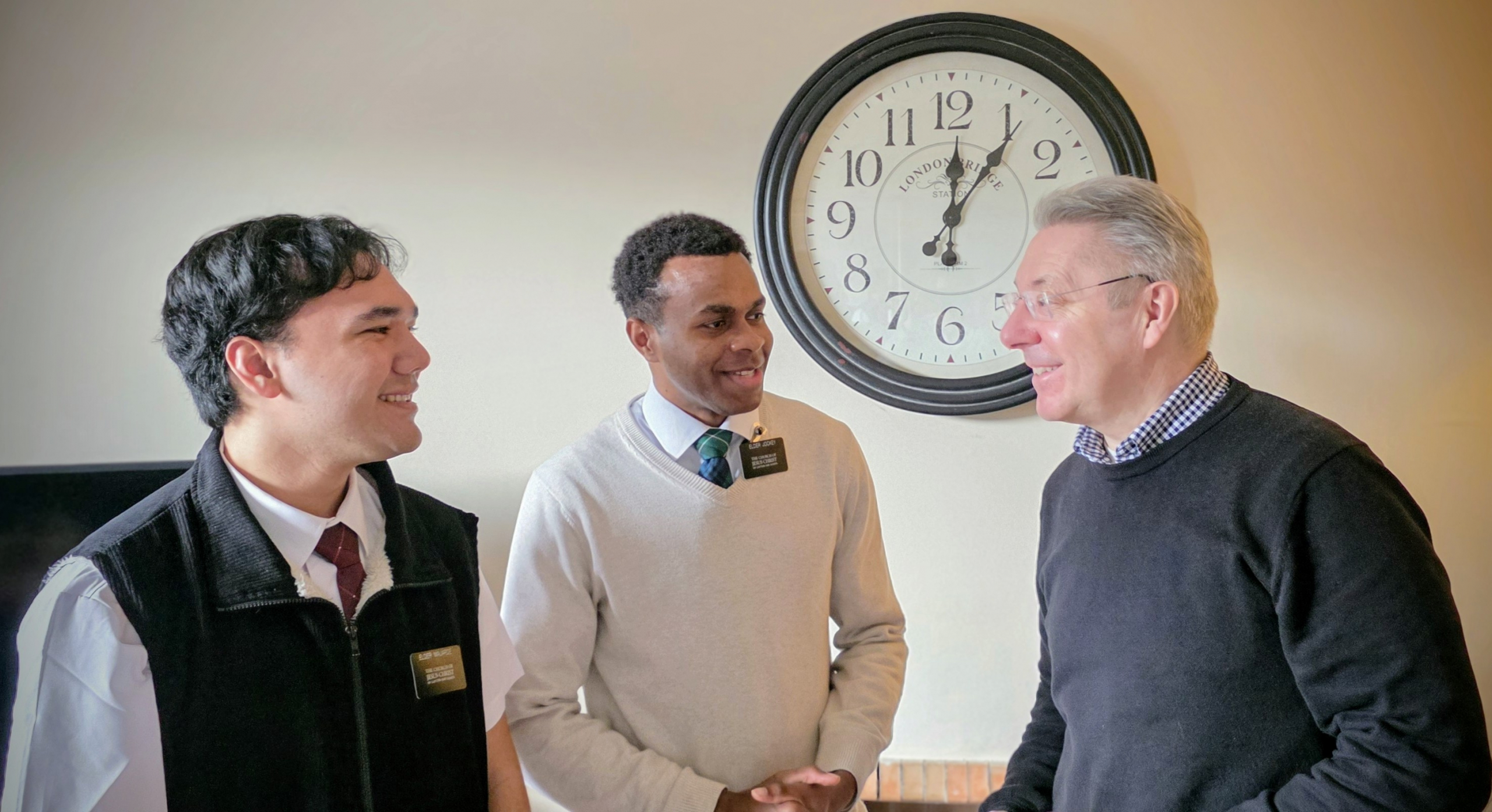
Every week, along with one or two others, I sit in a meeting to coordinate our missionary efforts in Dunfermline.
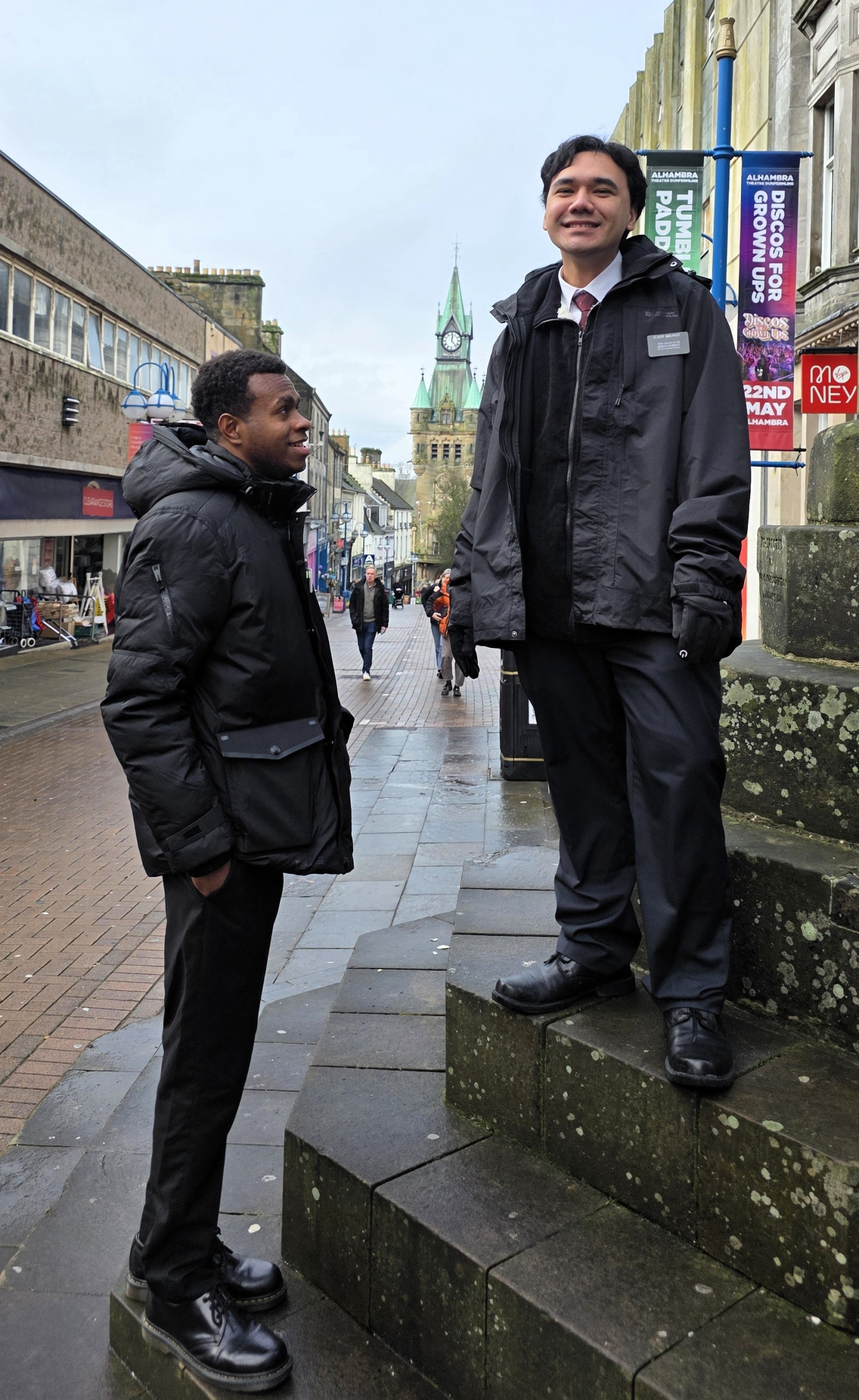
Two participants are our current missionary Elders Billy Jơckey and Angel Malarde, from the Pacific Islands of Vanuatu and Tahiti.
It’s funny that they are here together in a rather chilly Scottish winter!
Something happened this week, that made me think about them and the word “Elder”, in a slightly different way.
While facilitating a leadership programme, a behavioural change model was referenced by my colleague: Child, Adolescent, Adult, and Elder. Each state carries certain characteristics, depending on the situation.
We discussed the “Elder” state, which is typically wisdom-based, usually marked by perspective, steadiness, and a longer view of life.
As my fellow facilitator waxed lyrical about the “Elder” state, my thoughts drifted elsewhere.

My Understanding

I found myself thinking about the many missionary “Elders” I’ve known, hundreds, perhaps even thousands.
My lived experience of the word “Elder” was rather different from what was being described in that moment.
I don’t mean that unkindly, it’s simply my observation.
What struck me wasn’t that the model was wrong at all, rather it was the word “Elder” was being used in a very different way to how I’ve come to understand it through my lifetime.
In The Church of Jesus Christ of Latter-day Saints, Elder isn’t a developmental description, it’s an ordained office in the Melchizedek Priesthood.
We don’t wait until a young man has accumulated wisdom, perspective, or life experience and then say, now you qualify to be an Elder.
We do the opposite. We ordain first.
Responsibility is placed on young shoulders, and we trust that growth will follow.
Over the years, I’ve seen that growth happen time and time again.
Some of the youngest missionaries I’ve known have shown moments of remarkable wisdom, humility, and quiet maturity, often surprising themselves as much as anyone else – including me!
In essence they are becoming elders, long before they reach the age that the world associates with the term itself.
Reach out to them and find out for yourself!
What would it look like for you to live a little more “elder-like” today, regardless of your age?

Signals

At the start of our leadership session yesterday, my fellow facilitator was sitting in a very tall chair, and I was sat nearby in a much smaller one.
I couldn’t help myself; I looked up at her, then looked at all of the participants and made a silly comment about how it felt down in my seat, to some laughter in the room.
It was a fun light moment that struck me again this morning.
All of us are always sending signals, often without realising it.
They can take many forms.
It is not always the things we say or our tone of voice.
For example, through where we position ourselves, the space we take up, our body language or even the height of the chair we sit on.
These small, often unintentional cues can strongly influence how safe people feel to speak up, to question, or to offer a different perspective.
In Gestalt coaching, there is a simple idea that awareness precedes choice.
Until we notice what is happening, whether in the room, between people, or within ourselves, then nothing really changes.
Once we do notice however, even a small choice can shift the experience for everyone.
Soon after that moment, my colleague quietly went and found another tall chair, so we were more level again.
No explanation. No fuss. Just a small, thoughtful adjustment.
That is the kind of quiet leadership that often goes unnoticed.
Not loud or performative, but attentive and responsive.
A willingness to notice impact, not just intent and to act in the service of others.
It reminded me that leadership doesn’t always require a big intervention.
Sometimes it’s the smallest shifts that make the biggest difference to how people experience us.
Paying attention to these non-verbal signals can give you insights into what someone might be feeling, even if they’re not saying it explicitly.
We just have to notice.
What signals might you be sending without realising it?

Learning by Doing

Last week, whilst down in London, I spent some time with a couple of colleagues puzzling over a new activity for our learning programme.
The bench test in our team meeting suggested it needed a little tweaking. A few “what ifs”, some honest debate, a couple of scribbles on paper… and a revised version emerged.
Yesterday, it went live for real.
One of the things I enjoy most about my work as a facilitator is designing experiential activities that allow people to discover leadership and behavioural principles for themselves, rather than simply being told about them.
Yesterday was no exception.
As the activity was introduced in a very simple manner, I noticed those familiar puzzled expressions around the room, including the slight head tilt, the raised eyebrow, the quiet “I’m not quite sure where this is going…” look.
Off they all went…
Within minutes, those faces softened, conversations sparked, and each group leaned in, fully absorbed in the task at hand.
Half an hour later, as the groups returned to the main room to share their thinking, there was a gentle nervous anticipation in the air.
Presentations followed. Then table discussions. Then a facilitator debrief.

And so…?

And just like that, many of the leadership behaviours we’d hoped would surface began to reveal themselves – sometimes explicitly, sometimes subtly, often with a few smiles along the way.
Sitting there, as I observed it all unfold, I was reminded of something simple but important: you can learn a great deal by watching…
But the much deeper learning for us as facilitators doesn’t live in the design alone; it lives in the very moment, in how we read the room, respond to what’s emerging, and trusting ourselves to act accordingly.
And that’s the bit I never tire of watching happen.
Off to start day 2 this morning and learn a little more! 😊
What recent experience has quietly reshaped how you lead the way?

A Small Adjustment

It had been well over three years.
It was time.
I’d noticed in recent months, I was straining to see things at a distance.
During the eye test, the optician told me that although my eyesight was actually improving, I’d still need to get some new lenses to correct my sight.
I really liked the frame I have and so I shopped around a few opticians until I found one who’d be able to provide a similar one.
Yesterday, I collected my new glasses.
They looked identical to my last ones, except in two ways.
Firstly, you’d have to look closely, but the frame itself is a different colour.
Secondly, unless you were me, you’d be unable to see the difference, as it is the strength of the lenses that has changed.
Through the focus and strength of the lens, the result is I can see clearly again.
Nothing else has changed.
The world didn’t move closer.
The signs didn’t get bigger.
What changed was the way I was seeing.

Spiritual Insights

To me, that feels like a gentle spiritual truth.
Jesus said, “The light of the body is the eye: if therefore thine eye be single, thy whole body shall be full of light” (Matthew 6:22).
Sometimes faith doesn’t require a new view, just a corrected one.
Not a different world, but clearer sight.
David A. Bednar has taught “Spiritual discernment is not about seeing what others cannot see; it is about seeing what others can see but fail to notice.”
As we slow down, by taking time to live more deeply, perhaps the most important things for us to see clearly are who God is and who we really are.
I know personally that when our spiritual eyes begin to focus on Christ, our vision is sharpened around what matters most.
Perhaps the work of discipleship is not always about changing what is before us but rather allowing our vision to be sharpened so we can see what has been there all along.
What are you really focusing on right now, and does your vision need a small adjustment?

Care as a response to Chaos…

After a long and productive day of team meetings in London yesterday, returning to my hotel room late in the evening, (somewhat foolishly on reflection now) I turned the news on.

Some words came to mind as I watched the stories unfold, and wrote them in my journal.

Conflict.
Confusion.
Calamities.
Commotion.
Conspiracies.

I didn’t invite those words into my thoughts; they simply arrived there.

We do, indeed, live in perilous times.

For some, there is a growing collective anxiety, as these c’s of chaos flooded into my mind.

“What can I do?” I thought.

Then I recalled one of Stephen Covey’s simple models mentioned earlier in the day, the circle of influence and control. Thankfully, it brought some peace to my mind.

The model reminds us that there are many things we are concerned about, yet there are only a smaller number of things we can truly influence.

The trouble begins when we spend too much emotional energy living in the outer circle, where the headlines, the geopolitics, the speculation, the fear and anxiety can flourish – if unchecked.

But when I consciously stepped back into my own circle of influence, something shifted for me.

In the quiet of the hotel room, I drew a simple circle on the hotel notepaper and wrote down the C’s that matter most to me.

I realised that I can choose a different set of C’s to live by.

Again, my mind returned to one of Aviva’s core values that we’d been talking about earlier in the day – care.  As I did so, some other c’s came to mind…

Within my own circle of influence, I can choose care in how I treat others. I can practice compassion when fear shows up in a conversation. I can seek clarity in what I choose to watch and share. I can also cultivate calm rather than constant reaction. But above all I can act with courage by living my values quietly and consistently.

Of course, none of this will change the news headlines.

But it does change something closer to home.

It steadies my own inner world.

And perhaps, in some small way, it might help steady yours too.

Because when the C’s of chaos feel overwhelming, choosing the C’s of care within our own circle of influence, may be the most personal and the most powerful response we have.

Where can you choose care today?

The Parable of the bicycle – updated.

As a facilitator and a learning protagonist, over many years, I have lost count of the number of leadership models shared in workshops. I have probably forgotten more than I have remembered!

Which Model?

There are my favourites such as situational leadership, servant leadership, values-based leadership, action centred leadership, adaptive leadership and a whole list of styles and 4 box grids that I have used and am very familiar with. Recently however, towards the end of a workshop a curious thoughtful participant asked, “So, which leadership model is best?” A very direct question indeed. My response was a simple one, “well……that depends”

While most of us can recognise good leadership when we experience or observe it, oftentimes it is hard for us to determine the best model to use in a difficult situation, subsequently blending leadership models as needed is a popular fix. But then it struck me. As I reflected upon the many leadership experiences I’ve had in life, a clear analogy came to mind.

The Toolbox

As a child, I recall one day that I wanted to go out on my bicycle for a ride. Forlornly, there were several issues with my bicycle, including a wobbly seat, a flat tyre, a loose wheel, poor brakes, and handle bars that were more than just a little squint. I’d not been out for a ride in a while and sadly my bicycle had fallen into disrepair. I called my dad down to the shed in the garden. He came and looked at the bicycle commenting upon the amount of work it needed to get it back into shape.

After a long pause, I recall that he set to work immediately and pulled out a big box of tools. The box was a little higgledy piggledy, and as I learned throughout his life – that that was my dad! No matter, one small spanner was used to tighten the wobbly seat. Another set of tools were used to remove the wheel, repair the puncture and blow up the tyre again and tighten it into position. Dad then got out a set of pliers to fix the brakes. Finally, another wrench was used to straighten the handlebars. All in all, using a variety of tools, after a short time, the bicycle was fixed and off I went on my ride with a gleeful smile. “Dads are great” I thought!

So, it is with leadership. Oftentimes, whilst managing and leading others we are faced with a vast array of different problems, challenges and issues. Yet, just like the multitude of tools in my dad’s box, so we too have a broad range of different leadership models to help us resolve/fix/repair/manage/lead even the most mind-boggling obstacles at times.

Tools equip us with solutions. What new shiny model do you have in your leadership toolbox, or maybe that old well-worn rusty model, over there in the corner is the best solution perhaps.

“It depends” is indeed the correct answer after all.

  • Do you have a favourite leadership model?
  • How do you apply the “tools” in your day-to-day responsibilities?

Postscript – January 2026 – A short update: six years on

I wrote the original bicycle parable a few years ago.
Different problem. Different tool. Simple.

Recently, working at Aviva, I was asked a very similar question to the one that prompted the original post:

“Which leadership model should we be using?”

What struck me wasn’t the question. It was that my answer hadn’t changed.

It depends.

That phrase often frustrates people. It can sound vague or non-committal. But it isn’t. It’s precise.

Just like the bike, leadership problems are rarely the same problem twice. A loose handlebar isn’t a puncture. A puncture isn’t a brake issue. You wouldn’t reach for the same tool and hope for the best.

Leadership models are no different.

At Aviva, where I am working now there are many models available to use. That’s not confusion. That’s a toolbox.

The real work isn’t choosing the model.
It’s understanding the problem well enough to choose a tool and your mindset is key.

So, if my answer still sounds like “it depends,” that’s because leadership still does.

And that’s probably how it should be.


One Step at a Time

On a New Years Day trip to Glasgow, we enjoyed taking our grandson out for a while.
It was a chilly one, but we all got dressed as warmly as we could.
We headed towards the park and had some fun there.
At one point, he walked towards the steps and Monic said “just let him go, he loves steps.”
And off he went.
He has only been walking a few weeks, so I watched with interest how he’d master 4 flights of stairs.

Stepping Up

Step by step, he’d pull himself up, one by one.
He was frequently distracted by small pebbles, and he’d stop and try and pick one up, but with his winter gloves on that proved tricky for him.
I was behind him the whole time, to support and steady him on his big adventure, ready to step in if needed.
And every now and again, he looked around just to make sure that I was there.
Making it to the top seemed to me that it was a long way for him to go.
It proved to be a little too much and I helped him complete his journey in his time of need.

Help on Hand

Reflecting this morning, I am so grateful for all who have been there for me in my time of need.
Sometimes as we set out on life’s big adventure, unexpected challenges, difficulties and distractions can arise that can test us in many ways, temporally, emotionally, physically and spiritually.
Adversity is often the refining fire that can strengthen us in so many ways, including our faith.
Rarely by removing the challenge, but by reminding us that we are not alone in it.
Looking back, I can see how often help has come at just the right moment for me.
Through family. Through friends. Through quiet acts of kindness and timely reassurance.
And, at times, through the unseen watchful care of a loving Heavenly Father.
“I will also ease the burdens which are put upon your shoulders… that ye may know of a surety that I, the Lord God, do visit my people in their afflictions.” – Mosiah 24:14
As a new year begins, I’m grateful not just for the journeys we are invited to take, but for the help we are given along the way.
I am thankful too for the gentle reminder that when the climb becomes too much, there is always Someone close by, ready to steady us and help us home.
Who has helped steady you along the way?

Becoming along the Way

Since I was a teenager, goals have been a big part of my life.
Sometimes daily. Sometimes just sitting quietly in the background.
I’ve written five-year plans and even ten-year life plans. Some of them worked beautifully. Others, well, they didn’t work at all.
Yet both mattered.
Like many others, I’ve felt the pull of the New Year resolution (again). It got me thinking about the summer this last year and the walk along the West Highland Way.
The annual moment at new year, is when many of us will pause, reflect, and decide that something in our life deserves intention – that certainly happened last year.
Yet over time, I’ve learned that goals aren’t really about the calendar. They’re about direction.
Goals have never been about reaching a finish line for me, but about choosing who I’m becoming along the way.
They are also about the struggles and the stretching!
When goals succeed, they build confidence. When they fail, they build clarity.
Failure has been one of my greatest teachers. It forces reflection and invites learning.
I like the idea that FAIL simply means 𝑭𝒊𝒓𝒔𝒕 𝑨𝒕𝒕𝒆𝒎𝒑𝒕 𝑰𝒏 𝑳𝒆𝒂𝒓𝒏𝒊𝒏𝒈.
Most growth arrives that way, not through perfection, but through adjustment.
Looking back, the goals I missed shaped me just as much as the ones I achieved.
They helped me to understand my personal values.
They also showed me where I needed more patience, more honesty, and even more courage.
That’s the quiet power of goals. They don’t just guide what we do. They shape how we show up. In small, repeated choices, they help us become a little more aligned with who we want to be.
And in the end, that matters far more than any finish line.
Who are you becoming through the goals you’re setting right now?
© Copyright 2024 Daryl Watson. All Rights Reserved. Registered in Scotland, Company Number SC473068