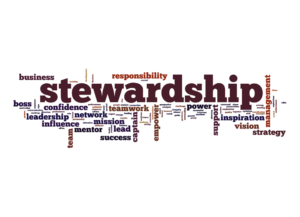
Stewardship
Think about it for a moment, we own very little, but are stewards over much!
As each year passes by, I have become increasingly aware of the illusion of ownership and the world’s pre-occupation with it. Oftentimes, I reflect on the fact we were born into this life with nothing, during our journey through life we exercise our greatest gift of agency, (the right to choose), and with the exception of our memories and experiences we depart this mortal life with nothing.
- Ownership is defined as “the act, state or right of possessing something”
- Stewardship is defined as “the activity or job of protecting and being responsible for something”
So here is the question – do you actually own your house, your car, or the latest gadget? Stop for a moment, really ponder over that question…… Is it really perhaps a matter of perspective and time? Consider this story: Two couples saw a masterpiece in a private gallery. “We must own it” said one. “It is so beautiful it possesses us, so we must possess it.” The other couple moved quietly away and said to each other, “Would that we could give it to all, place it in a public place for it is too beautiful to own and too uplifting to be kept from all”.
I have set myself a motto for this year “To BE and not to seem” which caused me to reflect on an experience I had on a business trip to India a few years ago. I managed to find some time whilst in Mumbai to visit the Mani Bhavan, which acted as the focal point of Ghandi’s political activities between 1917 and 1934. In the building there is a minimalist room where he ate, read, spun cloth, slept and received visitors. I came to realise that as Albert Einstein stated “Generations to come, it may be, will scarce believe that such a one as this, ever in flesh and blood, walked upon this earth”. Ghandi died “owning” fewer than 10 items – he truly understood the value of stewardship as opposed to ownership.
 I love this little story from Russell M. Nelson. “Sometime ago, as I was officiating in the nightly ritual of getting our little children into bed, I may have seemed a bit dictatorial with the directions to ‘pick up your clothes, brush your teeth’ and other such utterances. Then our five-year-old wistfully looked and said, “Daddy, do you own me?” While she has doubtless long since forgotten her question, I have remembered it as a challenge to distinguish carefully between ownership and stewardship. Often as parents and leaders we may be tempted to direct as owners rather than as stewards. In the last analysis, we own very little, but are stewards over much”.
Consider a few words – pride, envy, fear, stress, frustration. Now think about the cause and effect of these words. Remove the idea of ownership and the foundational characteristic of each of these words collapses. As we understand the reality of stewardship and apply the principle in our home, family and business life, we can replace these characteristics with their polar opposites – humility, empathy, courage, peace, fulfilment.
A friend recommended that I read “Tuesdays with Morrie” a true story by Mitch Albom, of experiences with his University Professor Morrie Schwartz. A remarkable testament of identifying what really matters most in our life and why we all need to slow down much, much more and enjoy the journey.
What does stewardship mean for you? Are you a good steward?
 Things are not always what they seem, and neither are people. I have been fortunate in life to meet some remarkable people and great leaders, endowed with grace, humility and goodness. No matter the situation, difficult or easy, their motto was clear…
 At the end of the day, a lone traveller crossed the finish line and wearily walked over to the king. He was tired and dirty – but he addressed the king with great respect, and handed him a bag of gold. He explained, “I stopped along the way to clear away a pile of rocks and debris that was blocking the road. This bag of gold was under it, and I would like you to help me return it to its rightful owner.” The King replied, “You are the rightful owner.” The traveller replied, “Oh no, this is not mine. I’ve never known so much money.” “Oh yes,” said the king, “you’ve earned this gold, for you have won my contest. He who travels the road best is he who makes the road smoother for those who will follow”. Author Unknown.
 – Being present, in the moment
 Firstly, Know Yourself. In order to make a good decision, you really need to understand yourself, your values and what makes you who you really are. There are lots of great personality tests on the market and working with a good personal coach will help you to identify what your core values are. When you know yourself, your core values and what you want out of life, decisions are a lot easier to make. By taking time here, it’ll enable you to really identify what the problem is that you are trying to solve.
 We started to explore what we each consistently do across the team. Picking up our markers, the flipchart was quickly filled as we recorded our competencies, processes, jargon, tools, equipment, along with our stories of success and failure. Dave had a new term for all of that too. And then it happened. We recognised that we were much, much stronger together, we were in sync, in one powerful moment, it felt safe with each other. I felt at home.


