A Pinprick of Light

Like many others, I got caught up in solar eclipse fever on Wednesday evening.

After watching the early evening BBC news – much of which was dominated by the excitement of the eclipse across the UK, I decided I ought to join in.

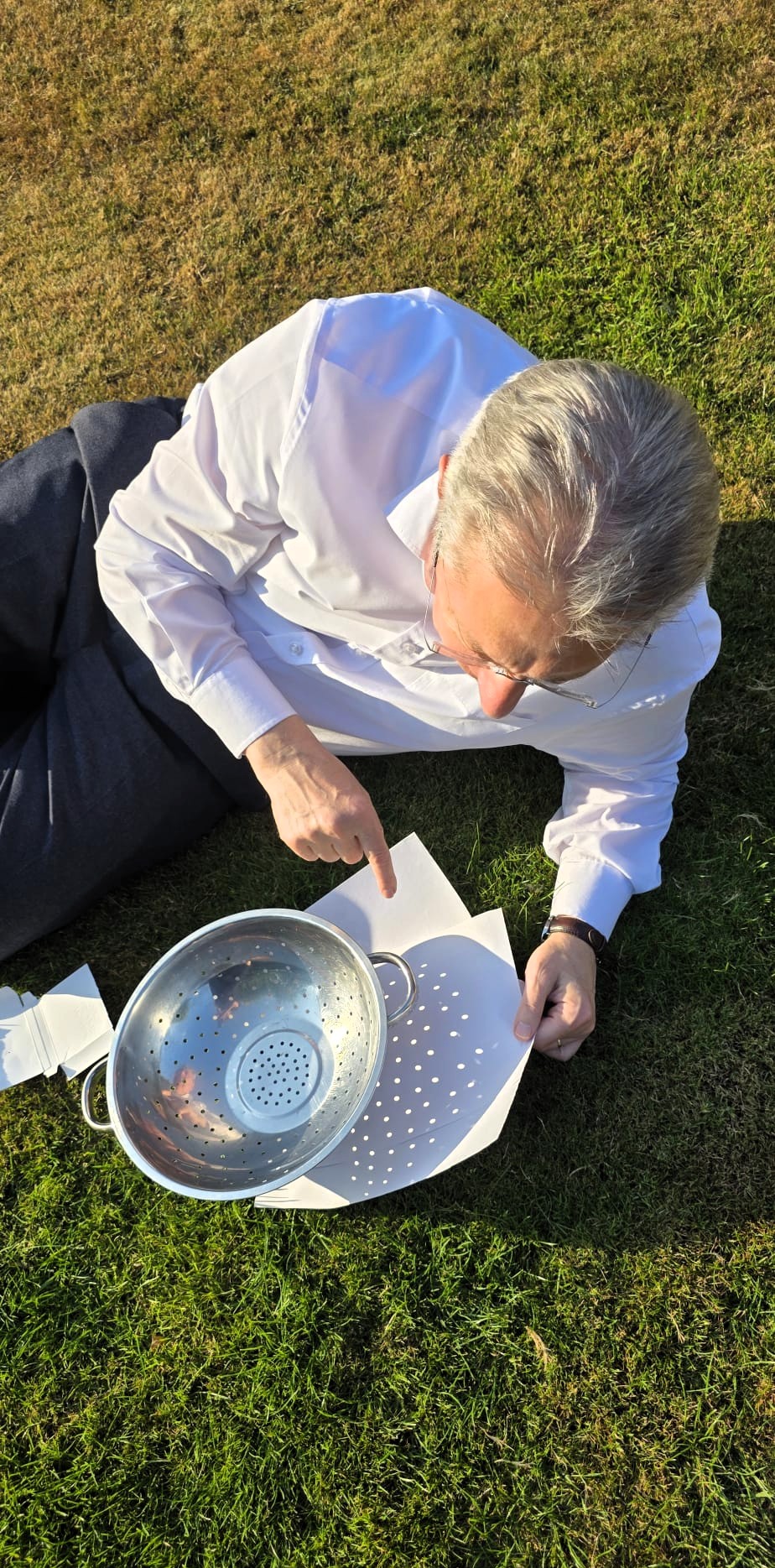
Monic and I were staying at the Preston Temple for a few days, so naturally I reached for the most obvious piece of scientific equipment available to me – a colander!

Out into the evening sunshine I went, holding it over a sheet of paper, watching dozens of tiny crescent-shaped images appear.
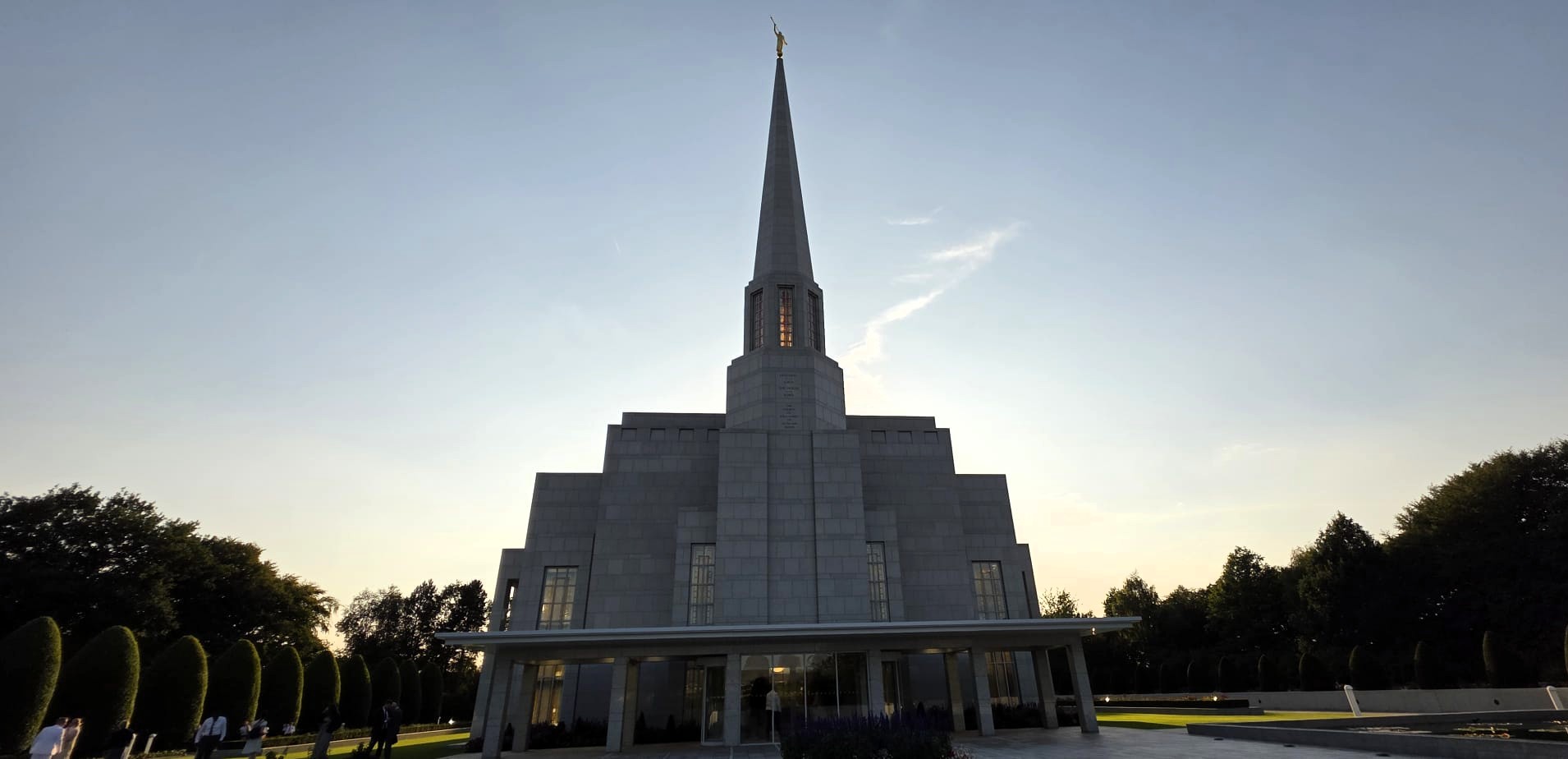
Later, Monic and I walked up towards the temple and were surprised to find quite a crowd gathered outside.

It was fascinating, as there were all sorts of wonderful contraptions in operation. Cardboard boxes had been adapted into viewing devices. Pieces of paper were being held at unusual angles. Advice was being freely dispensed to anyone who looked remotely interested.

There was, however, a real shortage of actual eclipse glasses.

For a few minutes, the temple grounds seemed to have turned into an impromptu science fair.

Then I spotted my favourite method of the evening.

One dear friend took a safety pin and made a tiny pinprick through her temple recommend, using the little hole to catch an image of the eclipse.

As I looked more closely, I noticed the image of Jesus Christ on the recommend.

And in that small moment, something shifted for me. What had begun as something fun and light-hearted became a little more meaningful.

Thoughts Change…

Here we were, standing beside a temple decorated with images of the sun, moon and stars, watching one of those great heavenly bodies pass in front of another.

The thought came quietly: Is there a God? Is there a Creator?
Bruce C. Hafen once used a striking image when considering that kind of question:

“What are the odds that a tornado spinning through a junkyard would create a Boeing 747?”

Alma gave his own answer centuries earlier when he said to Korihor: “All things denote there is a God; yea, even the earth, and all things that are upon the face of it, yea, and its motion.” – Alma 30:44

And perhaps that is part of what happened for me that evening.

The fun of the colanders, cardboard boxes and improvised contraptions gradually gave way to something quieter.

The Lord said:

“… Behold, I am Jesus Christ, the Savior of the world. Treasure these things up in your hearts and let the solemnities of eternity rest upon your minds.” Doctrine & Covenants 43:34

Standing there beside the temple, watching the movement of the sun and moon, that phrase seemed especially fitting.

Perhaps, in the very act of Creation, our Heavenly Father and Jesus Christ anticipated moments just like this, when generation after generation will look up at the sun, moon and stars and catching a glimpse of the wonder behind it all.

For a few moments, the solemnities of eternity really did rest upon my mind.

I don’t pretend that an eclipse proves the existence of God.

But for me, it certainly points towards Him.

The more we learn about the universe — its order, its laws, its movement and the extraordinary conditions that make life possible — the more wonder there seems to be.

What began that evening with a colander, a few homemade contraptions and a safety pin ended with a quiet reminder.

Sometimes the heavens really do declare something.

And sometimes all it takes to notice is a tiny pinprick of light.

What has caused you recently to look up, pause, and wonder at the hand of God?

The Bridges We Keep

Yesterday we had one of those lovely reunions that reminds you just how quickly the years pass by…
More than two years ago now, Jaya Gilbert was serving as a missionary with us in the Belgium Netherlands Mission. Originally from New Zealand, she is now in Edinburgh performing at the Fringe in Stay, a production by BYU–Hawaii Polynesian Theatre.
So, with a few hours together, Monic and I became tour guides again. 😊
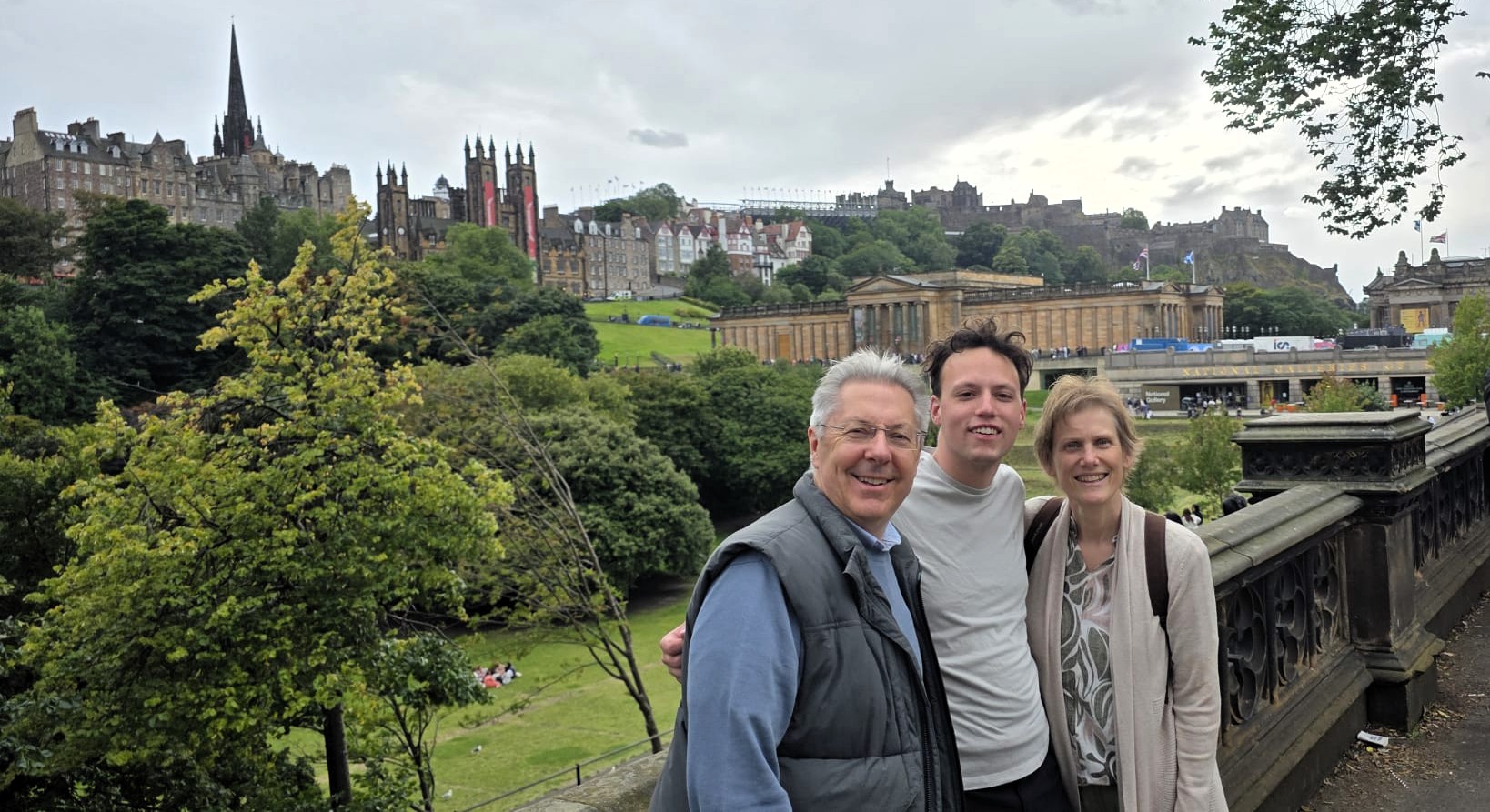
We showed Jaya a few favourite places around Edinburgh and Fife, stopped by the Forth bridges for photographs and eventually made our way to Culross, where we enjoyed a wonderful meal together at the Red Lion.
Afterwards we headed through Alloa where she has strong family history connections, before stopping at the Wallace Monument.
Reflecting back this morning on the picture of us standing beside the Forth Railway bridge, I found myself thinking about bridges of a different kind.

Bridges

Missionary service seems to build them almost without us noticing.
Bridges between countries and cultures.
Between generations and backgrounds.
Between people whose lives, under normal circumstances, may never have crossed at all.
Then the mission ends.
Transfers stop. Name badges come off. Everyone heads home and life moves quickly onwards.
Yet many of those bridges remain.
Sometimes months or even years pass without seeing one another, and then suddenly you are together again — and somehow the years in between seem to melt away.
Yesterday was one of those days.
It reminded me that one of the greatest blessings of those three years in Belgium and the Netherlands wasn’t simply where we served, but who came into our lives because we served there together.
More than two years later, it was a joy to have Jaya with us again and to be reminded just how deeply these wonderful missionaries have become woven into our lives, as we laughed and reminisced throughout the day.
Perhaps that is one of the quiet miracles of service.
We set out hoping to make a difference in the lives of others, only to discover that they have become part of ours.
Who has come into your life through service — and stayed there long after the service itself was over?

The Music That Remains

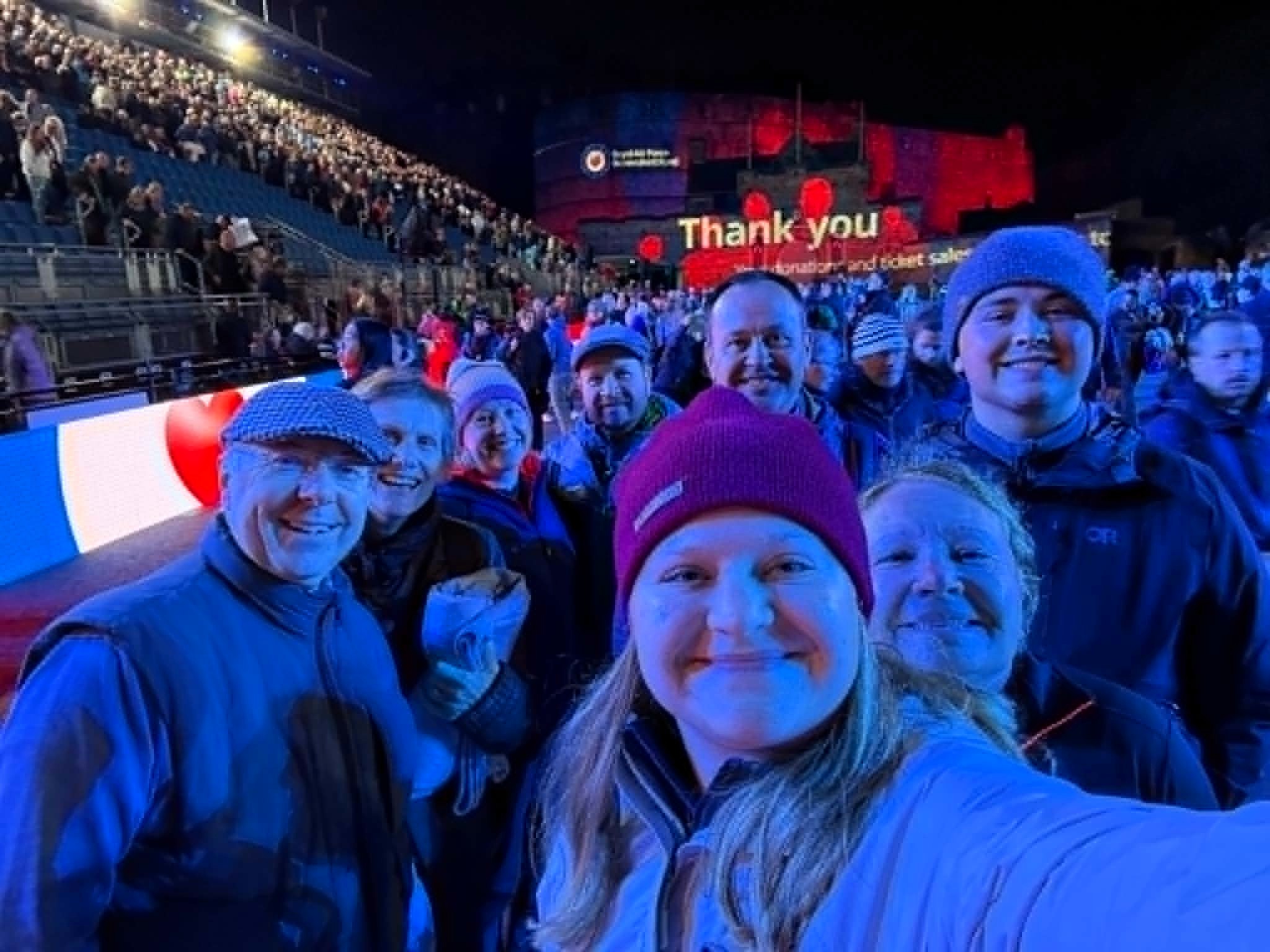
With the Royal Edinburgh Military Tattoo and the Festival Fringe now well under way, Auld Reekie has once again been filled with music, colour and tens of thousands of visitors.
Monic and I spent the last couple of days in Edinburgh – and we can definitely confirm… it’s very busy again… you can hardly move!
We didn’t so much walk through the streets as shuffle along with several thousand new friends.
On a lovely clear Friday evening, from our seats on the esplanade beneath the walls of Edinburgh Castle, we loved the unmistakable sound of bagpipes galore, massed military bands and music from around the world. There was marching, lots of dancing, colour and spectacle aplenty as the Tattoo unfolded before us.
On Saturday afternoon, the music sounded rather different and somehow the streets were even more crowded!
We’d returned to see the BYU Young Ambassadors perform their lively mixture of contemporary music, singing and dance. It really was great fun.
Two days and two very different performances.
Yet for Monic and me, another, quieter melody ran through them both.
At the Tattoo, we were joined by Mallory Grunander, her parents and other family members. Mallory served with us as a missionary in Belgium and the Netherlands.
At the Young Ambassadors show, we met another of our former missionaries, Dallin Doxford.
Their missionary name tags have long since been removed and the daily missionary schedules have ended.

Friendships

Yet our friendships remain as strong and vibrant as ever.
Over Vietnamese food with Mallory and Italian food with Dallin, we caught up, shared memories and created some new ones together. Apparently, missionary reunions are best conducted with an international menu! 😉
Paul beautifully described the bond that can grow through serving together: “…we were willing to have imparted unto you, not the gospel of God only, but also our own souls, because ye were dear unto us.” – 1 Thessalonians 2:8
Those words capture something of how Monic and I feel about Mallory, Dallin and all the hundreds of missionaries who shared such an important season of life with us.
Missions eventually end, people move on and the music changes – but the love, laughter and shared faith continue to echo across the distance and the years.
Some music lasts only for a performance.
Other music remains in our hearts forever.
Whose friendship still brings music to your life, long after the season you shared has passed?

A Flurry of Facilitators

A group of lions is a pride.

A group of geese is a gaggle.

And apparently, a group of facilitators may well be a flurry — at least according to one of my colleagues.

I heard the phrase a week or two ago while working alongside several fellow facilitators, and somehow it feels pretty accurate.

Facilitation often begins quietly.  There is thinking, pondering and preparing to be done. Plans are made, activities discussed, flipcharts arranged, PowerPoint slides adjusted and everything carefully set in order.

Then the participants arrive and suddenly, the flurry begins.

Ideas are flying, conversations are flowing, chairs are moving, and carefully prepared timings are being treated as gentle suggestions rather than firm commitments.

There is always energy, laughter and the occasional moment when everyone looks towards the facilitator as though we should know exactly what is happening — and have the answer to everything. Naturally, we smile confidently.

Eventually comes the familiar task of gathering everyone back together (which happens several times on any given day), a process often described as herding cats.

Cats, of course, are not natural herd animals. Unlike sheep, horses or cows, they generally prefer to go their own way, follow whatever has caught their attention and return only when they are good and ready.

Much like participants on a Lead the Way programme.

Some are finishing their coffee. Others are making another loo trip, answering an urgent email, or becoming absorbed in a fascinating conversation that has absolutely nothing to do with the session.

And then there are usually a few who appear to quietly wander off altogether.

Cat Herders

Thankfully, my fellow facilitators are not only thoughtful, skilled and experienced — they are also expert cat herders.

It may not appear on the formal facilitator job description, but perhaps it should:

Essential skill: the ability to gather independent-minded adults back into a room without appearing to chase them.

And then, almost as quickly as it began, the room grows quiet again. The participants leave. The flipcharts remain. The facilitators pause, reflect and ask the traditional post-session question:

“Did that go the way we planned?”

Usually, the answer is: “Well… not entirely.”

And often, that is where the best learning happened.

So yes, a flurry of facilitators feels just right: moments of stillness and thought, followed by a wonderful burst of movement, creativity, conversation and barely controlled chaos.

All held together by a small group of people who know how to ask good questions, follow the energy in the room — and gently herd the occasional cat.

What collective noun would you use for a group of facilitators?

The Boy on the Bridge

Walking down to visit my mum yesterday morning, I chose to walk through the Rex Park.
As I crossed one of the bridges, I noticed a young boy, maybe around four years old, standing all alone and looking particularly glum. ☹
His arms were folded, feet firmly planted and a face suggesting that life had treated him very unfairly.
At first for a brief second or two, I was a little concerned and wondered why he was standing there by himself.
Then, looking across to the other side of the bridge at a little bit of a distance, I spotted a concerned parent watching him.
As I approached her, I asked, “Is he in a huff?”
“Yes – a big one!” she replied.
We smiled, I wished her good luck and then carried on towards my mum’s.
It was only a small moment, but as I reflected on it this morning, my mind flashed back to similar occasions with our own children some twenty+ years ago, and some of the occasional grumpy tantrums we endured.
As a concerned parent, I recall I’d try all the usual stuff, like reasoning, distraction, humour, and occasionally, pretending to carry on without them while quietly checking over my shoulder at the same time.
Yet experience taught me that often the best thing I could do was stay close, give whoever it was a little space, patiently wait for the huff to run out of steam… and for those firmly folded arms to finally unfold.

The Lesson

In some ways, that feels like our relationship with our Saviour, Jesus Christ.
Sometimes we may find ourselves standing still, spiritually disappointed, frustrated or even quietly “in a huff” because something has not worked out and life hasn’t gone as we’d hoped.
At other times, we may simply wonder why Jesus Christ seems so distant from us.
Yet perhaps He is much nearer than we realise: watching carefully, loving completely and patiently waiting for us.
I know, He will never force us to move, but rather, He continually invites us to turn, soften our hearts and take one small step towards Him.
I remember clearly those tender moments when our children eventually turned and drew close once again.
In the scriptures, Doctrine and Covenants 88:63, the Saviour promises: “Draw near unto me and I will draw near unto you.”
Where in your life might the Saviour be inviting you to take one small step towards Him today?

Off You Go Then…

Earlier this week, Annmarie and I were preparing to welcome a brand-new cohort to another Lead the Way programme with Aviva in Perth.
We really enjoy working together and we’d taken a wee bit of time to prepare a plan for the session by dividing up the sections and agreed who would lead each part.
Everything was organised, or so we thought. 😉
As the session began, Annmarie and I stood at the front of the room and looked at one another.
There was a brief pause.
“Off you go,” I thought.
But she didn’t start.
Instead, she looked back at me with a slightly quizzical expression, which I interpreted as her perhaps needing a little encouragement.
So, I gave her what I imagined was a wonderfully supportive leadership signal: a gentle tilt of the head, raised eyebrows and an encouraging look that clearly said, “You’ve got this.”
Still, she hesitated.
Eventually, I added the words: “Off you go then.”
And off she went.
She welcomed the group, introduced the session and got us underway nicely. Nobody in the room appeared to notice that anything unusual had happened.
A few minutes later, during a short break, Annmarie leaned towards me with a big smile and whispered:
“You were supposed to start… Check the plan.”
Naturally, I did and she was right! I hadn’t checked the plan carefully enough!
We laughed about it and carried on. No harm was done, the session had begun well, and in fact, the little incident probably helped us to relax as we started working with a new group.
It was a small moment, quickly forgotten by everyone else, but a useful reminder for us.

The Leadership Lesson

In leadership and coaching, we can easily assume that a plan, a look or a subtle hint has made everything clear.
Sometimes it has. Sometimes it really hasn’t.
Often, the warmest and most helpful thing we can do is simply ask the question rather than rely on raised eyebrows and hopeful head tilts – although that can be fun too!
Where might one simple clarifying question prevent a bigger misunderstanding for you this week?

Stories that Help us See

I tell stories all the time.
At work, I use storytelling to make coaching and leadership ideas more memorable.
During our mission in Belgium and the Netherlands, I often shared stories to teach, encourage and help people see the hand of God in their lives.
And in my writing, I regularly return to ordinary everyday moments, a simple conversation, a journey, a misplaced object, a football match or a quiet walk and try to find the meaning hidden inside them.
Recently, I read a thought about storytelling that felt very familiar.
Good storytellers often appear to be speaking completely off the cuff, as if it is unprepared and unrehearsed. The story sounds natural, spontaneous and oftentimes conversational. Yet beneath that apparent ease, there has usually been some preparation. They know where the story begins, they understand its important moments, and they know where it is going to end.
That is certainly true for me.
Sometimes I will turn a story over in my mind during my morning study, or while driving to Perth, or whilst taking a walk and asking myself what the story is really about.
As a youngster, it was during my study of the scriptures and church history that I discovered the power of storytelling.
David facing Goliath. Joseph and his coat of many colours. Daniel in the Lions’ Den. A father watching the road for the return of his lost son. Nephi returning for the plates. Alma the Younger awakening to the mercy of Jesus Christ. The Pioneer Trek…
The Saviour Himself frequently taught through stories, or parables.
He spoke of seeds, sheep, lamps, coins, vineyards and travellers on dangerous roads. His stories were simple enough to remember, yet deep enough to change a life.
“And with many such parables spake he the word unto them, as they were able to hear it” – Mark 4:33
I know that Jesus did not tell stories merely to entertain people. He told them to help people see differently.
Perhaps that is the spiritual purpose of some of our own stories too.
Our experiences may not seem dramatic. Most of life is not lived on battlefields or beside the Sea of Galilee. It is lived in kitchens, workplaces, hospital corridors, classrooms, churches, gardens and ordinary family conversations.
Jesus Christ is present in ordinary places. Our challenge is learning to notice Him in the everyday moments of our lives and to follow Him.
Then remember the moments that mattered.
Because the best stories do more than describe what happened.
They help us recognise what God was doing while it happened.
When you look back, where can you now see that God was present all along?

Beyond the Badge

Another Lead the Way programme cohort concluded earlier this week for me with Aviva in Perth .

One of the unexpected highlights was the development of a rather unlikely new friendship.

I am a supporter of my local football team, Dunfermline Athletic. During introductions on our first day, I discovered that one of our participants, Andrew, regrettably, supports Falkirk.

For those unfamiliar with the finer points of Scottish football, this is not an insignificant detail. We are proper rivals.  The kind of rivalry where friendly conversation is perfectly acceptable, provided it includes a little teasing, a suspicious glance and the occasional reminder of who supports the better team.

So, naturally, when we first met, we played it up.

There was banter. There were accusations. There may even have been some wholly objective observations about the questionable judgement required to support Falkirk or Dunfermline for that matter.

But something rather lovely happened as the programme continued: we began to discover how much we had in common.

We both have strong backgrounds in sales. I’d also previously carried out some learning and development work in Andrew’s former company. We share similar interests and experiences.

We are also both relatively new to Aviva, having joined within the last year.

And then came the real surprise – both our wives are Dutch.

That unusual discovery opened up an entirely new conversation about the Netherlands, language, culture, family life and some of the shared experiences that come from being married to Dutch women.

Suddenly, the football rivalry seemed a little less important.

Leadership can sometimes be like that.

We meet people through the labels we can immediately see: department, organisation, role, background, nationality, belief, or sometimes even a football team. Those labels can create distance before a real conversation has even begun.

It’s my experience that good leaders remain curious, moving beyond the badge to discover the person.

They ask questions, listen carefully and look for the experiences, hopes and values that connect us. It doesn’t mean pretending that our differences don’t exist. Andrew will still support Falkirk, and I will continue trying to help him see the error of his ways… 😉

But differences do not have to become divisions.

Sometimes the person standing on the opposite side of a rivalry has far more in common with us than we first imagined – that was our experience this week.

Perhaps leadership begins when we stop asking, “Which side are you on?” and become curious enough to ask, “What might we share?”

What might you discover if you became genuinely curious?

Rivals may not always change their colours, but with a little humour, openness and genuine conversation, they can certainly become friends.

The Language of Friendship

Yesterday, Monic and I collected our dear friend Ans from the airport, arriving from the Netherlands.
Our friendship stretches all the way back to 1985, when Ans and I were both serving as young missionaries in the England London Mission. Life carried us in different directions after that, but our friendship was renewed and deepened during the years Monic and I served as Mission Leaders in Belgium and the Netherlands.
Some friendships seem able to pick up a conversation even after many years have passed.
We spent the afternoon catching up wandering through the cobbled streets of the little historic village of Culross and then afterwards over a lovely meal at the Red Lion Inn.
Of course, the first challenge was learning how to pronounce its name.
Culross looks as though it should be pronounced exactly as it is written. It is not.
The correct pronunciation is closer to “Coo-riss.”
With one Scottish accent, two Dutch accents and more than one language moving around the table, there were a few attempts for sure. Throughout the day, words were misheard, syllables wandered off in unexpected directions and familiar expressions sounded entirely unfamiliar in someone else’s accent.
There were a few giggles too.
Yet beneath all the teasing and mispronunciation was something rather beautiful. We didn’t need to speak with the same accent to understand one another. And we didn’t need perfect words to know that we were loved, welcomed and valued.

Languages

Perhaps friendship has its own language.

The Book of Mormon describes a people who had their “…hearts knit together in unity and in love one towards another.” – Mosiah 18:21
That phrase seemed quite fitting yesterday.
Our accents were different. Our languages occasionally became tangled. Some words needed repeating, and the pronunciation of Culross caused a little amusement for us all. Yet our hearts understood one another perfectly well.
Perhaps that is one of the quiet miracles of enduring friendship.
Time may pass, geography may separate us and life may carry us through very different experiences, but love can knit the years together again.
God does not require us all to speak alike, sound alike or come from the same place. He simply invites us to draw closer, listen generously and allow our hearts to be joined in love.
Yesterday, in the little village of Culross – or Coo-riss, if you are saying it properly – I was reminded once more that the loveliest conversations are not always the most fluent ones.
They are the ones in which friendship does the translating.
Who might need to hear the language of your friendship today?

Finding North

Last week, during another Lead the Way programme, a small theme quietly appeared in the room.

Early one afternoon, my co-facilitator Melody had referenced an image of a compass and spoke about the significance of direction.

A little later, during an activity on change, one of our participants, Greta, used the word compass again.

That caught my attention.

I always carry a small compass in my backpack. It was a 60th birthday gift from my brother and sister-in-law last year, and for me it has become more than a lovely keepsake.

It is a reminder to keep asking myself: What direction am I choosing?

An activity sprang to mind.

In that moment, I asked all 27 participants to stand, close their eyes, and point north.

Whilst their eyes were closed, I placed my compass on a table to reveal true north.

When they opened their eyes, the room was chaotic.

Fingers were pointing in almost every possible direction. One person was even pointing confidently towards the ceiling!  There was a fair amount of uncertainty.

Only a few were actually pointing north.

It made us all smile, but it also made us think, because leadership can be like that.

We can be in the same room, part of the same conversation, facing the same change, and still have very different assumptions about where “north” actually is.

That is why direction matters.

In Lead the Way, the compass is also part of our programme branding, and perhaps that is why the moment landed so well. It was no longer just an image on a screen or a symbol on a wall, it had become a lived metaphor in the room.

A central theme on the programme is when we ask our participants shape to their “I am” statements, where we hope they are not just writing words, but creating a compass for the kind of leader they are choosing to become, in order to literally Lead the Way.

A reminder of what they stand for.
A guide when change feels disorientating which can happen regularly.
A way of noticing whether their behaviour is aligned with their intention.

The compass is a simple symbol, but it carries a deep leadership question:

Do you know where you are heading, and are you helping others find direction too?

Sometimes leadership begins with exactly that, by simply finding your true north.

© Copyright 2024 Daryl Watson. All Rights Reserved. Registered in Scotland, Company Number SC473068