A Quiet Carriage

On my return journey home yesterday from Preston on the train, I settled into my current book, “The Anxious Generation” by Jonathan Haidt.
It has been a convincing read, backed up with reams of scientific research into how smartphones have transformed the lives of millions of children and adolescents, especially Gen Z and Gen Alpha.
Haidt outlines how play-based childhoods have been replaced by phone-based childhoods and explains the connection between the global rise in anxiety, depression, and other mental health conditions.
One of his core arguments is that over the last 15 years this generation has been shaped by a constant digital pull…not occasional smartphone use, but near-continuous engagement.
I was listening to Radio 4 last week on the same issue, and our own UK Government is now considering restrictions on under-16s’ usage, similar to those already introduced in Australia.

My Observations

Sitting on the train home, every now and again I lifted my head from my book and looked up and down the carriage and across the aisles… I could hardly believe my own eyes.
Almost every head was bowed, not in prayer, but immersed in a screen, in their own digital world.
Young and old alike.
Scrolling, tapping, swiping. Not frantic. Just absorbed. Quietly hooked.
Sitting there, it felt less like choice and more like habit. Less like connection and more like compulsion… even addiction.
Phones don’t just entertain.
They interrupt boredom, soften discomfort, fill silence, and reward attention.
Over time, they train us to reach outward whenever we feel the slightest unease, rather than inward, or even upward.
Our smartphones are undoubtedly both a blessing and a curse.
They connect us to a world of remarkable information and allow us to speak with anyone, anywhere, yet they can also impact our mental, physical, and spiritual health.
Some years ago, Russell M. Ballard taught that smartphones “need to be our servants, not our masters.”
Perhaps one of the most counter-cultural acts of discipleship today is not rejecting technology, but reclaiming stillness… choosing, even briefly, to put the phone down and sit with the quiet.
In that space, we may hear again the Lord’s gentle invitation, “Be still, and know that I am God” (Psalm 46:10), and ask whether our phones are serving us… or quietly shaping us.

Let’s take this for a walk…

Yesterday on a Lead the Way programme for Aviva in Perth, my colleague invited participants to leave their chairs behind and head out for a walk-and-talk coaching conversation.

As people paired up and started moving, I was reminded once again of the quiet power of coaching on the move.

I recalled a moment from a few years ago, when I was asked: “Where is the best place for a coaching conversation?”

I think I’ve coached in just about every setting you can imagine.

These days it’s more often on Zoom or Teams.

However, over the last few years, it’s also been parks and beachfronts as well as offices, hotel receptions, coffee shops, trains, planes, taxis, corridors, and more conversations in my own living room than I ever expected when I first trained as a coach.

What I’ve learned is this: Coaching conversations can happen anywhere.

But the best place is always the one where the coachee feels safe, at ease, and able to speak freely about what really matters.

Like yesterday, walking together added something extra.

Participants tend to be calmer, less tense, and more open than when sitting in a chair.

The shared movement can soften the intensity, reduce the pressure of eye contact, and help thoughts flow more easily.

Research also shows that it boosts creativity and cognitive flexibility.

A change of scenery often helps to change the conversation.

It shifts the energy, the pace, and sometimes the insights too.

What matters most, though, is presence.

Being fully there, in mind, body, and spirit.

Two people genuinely paying attention to one another and actively listening.

In one conversation I had yesterday, somehow the topic of Gleneagles Hotel arose.

And yes, for the record, one of the very best places I have ever coached was the restaurant there… where the coaching came with a beautiful lunch that my client kindly paid for!

I remain open to repeating that particular environment once more! 😉

Commonly leadership development looks like frameworks and models.

But in my experience, sometimes it looks like a good walk, an open conversation, and making time for some space to think.

How does changing the setting change the conversation for you?

Be Prepared

Our Monday morning team call yesterday was focused on something very practical: contingency planning.
Some of my colleagues had clearly put a lot of thought into how we prepare for disruption around our Learning Programme, Lead the Way, in Perth. With participants travelling from far and wide, winter brings the real risk of snow, heavy rain, and the knock-on effects that tend to follow travel delays.
The conversation wasn’t about predicting every possible problem, although we did talk through quite a few. It was about agreeing a set of guiding principles so that, whatever happens, we’d be ready to respond accordingly.
After the call, I found myself thinking about an idea that’s been with me far longer than any programme plan.
When I was much younger, I was a Cub Scout. Our motto was simple: 𝑩𝒆 𝒑𝒓𝒆𝒑𝒂𝒓𝒆𝒅.
I have thought about that motto often throughout my life.
Back then, that meant remembering my kit, listening to instructions, and having some idea of what to do if plans changed. At the time, it felt small and practical.
Looking back now, it feels like an early lesson in something far more useful: how to face the unexpected with confidence rather than fear, and how to take responsibility not only for myself, but for others too, when things don’t go to plan.
That same principle sits at the heart of learning, leadership, and development.
Good learning isn’t just about information. It helps us think ahead, make sound judgements, and act when the situation isn’t clear.
Leadership development builds the confidence to move forward without perfect answers and the awareness to support others through change.
Together, they don’t remove all disruption, but they help us respond with agility when it matters.
It’s been my experience too, that our careers and lives are rarely linear.
Plans shift, priorities change and disruption can show up in many forms. What matters isn’t whether it happens, but how we respond when it does.
That’s why yesterday’s conversation mattered.
By agreeing shared principles and preparing together, we weren’t just protecting a programme. We were reinforcing a mindset that accepts uncertainty and treats preparation as a shared responsibility.
In that sense, for me, the Cub Scout motto still holds up remarkably well, even after all these years.
Learning, leadership, and development help us be prepared not for one specific scenario, but for whatever comes next.
So perhaps the real question is this: when your plans change, are you ready to adapt?

No Spark at Breakfast

Yesterday, whilst enjoying breakfast, Monic shouted from the kitchen “the gas hob isn’t working…” “the gas isn’t igniting.”
I wandered through, twisted the knob and sure enough… no clicking and no spark.
Perhaps something serious was wrong.
We tried again, checked the burners, then got the matches.
We persevered with matches and the burner lit.
“That’s strange” I thought, now mildly concerned.
Eventually, after a little online consultation and a bit more head-scratching, the truth emerged.
I returned to the kitchen and made an incredible discovery…
Somehow – one of us had turned the electricity off!
Yes – that simple!
The gas hob was absolutely fine.
The gas was ready.
The flame was willing.
It just had no power to spark.
As soon as the switch went back on, click…then instant flame!
We both smiled, as we burst into laughter together. (Old age? Possibly. 😄)
How often are we a bit like that hob?
I couldn’t help but smile at the small lesson in it all.
Nothing was broken.
Nothing was missing.
We just needed to switch the power back on.
Sometimes faith is a bit like that.
We keep trying harder, compensating, improvising, when what’s really needed is to quietly reconnect to the source.
As Russell M. Nelson once said: “Faith in Jesus Christ is the greatest power available to us in this life.”
Faith, I’m learning, doesn’t have to be loud or heroic.
Sometimes it’s just the small spark that comes when we reconnect to Him, and suddenly, light appears far more easily than we expected.
What spark might be missing in your faith right now?

Better Together

Back in June last year, I found myself in Rome at a 2-day conference.

After 13 years of working for myself, I was feeling a little restless. I was older, the market had shifted, and I sensed it might be time for something a bit different.

An opportunity popped up in a group chat, and on a bit of a whim, I responded.

A few hours later whilst at the airport waiting to fly home, I had a conversation with Sophie.

A few weeks passed…and, as they say, the rest is history, starting with Aviva on September 1st.

This week, we’re co-facilitating together again in Perth.

Co-facilitation is when two or more facilitators deliver a session as a team.

It means sharing responsibility, switching between leading and supporting, and staying in tune with the room throughout.

Minute by minute, hour by hour, our working relationship really matters.

When you work with someone you genuinely get along with, something shifts in the room.

There’s ease and trust – constantly.

A real sense of “we’ve got this together.”

To me it seems we listen better, adapt faster and learn from each other.

I have noticed that we’re able to laugh when things don’t go exactly to plan – and somehow we seem more resilient too!

Managing energy levels, keeping an eye on group dynamics, being the subject matter expert or even the timekeeper – all to ensure great outcomes, is a genuine joy with Sophie.

In leadership and in learning, we often focus on what we deliver:
The content. The outcomes. The impact.

But just as important is how we stand alongside one another while doing it.

Because when people work well together – truly well – it shows.

Participants feel it. Energy lifts. Conversations deepen.

And the work becomes not just effective, but really enjoyable.

Over the next two days, we’ll facilitate discussions, invite reflection, and hold space for learning. But underpinning all of it will be something quieter and more powerful:

A good working relationship.
Built on trust.
Strengthened by humour.

And occasionally like yesterday sharing a memory of NHS milk bottle glasses, when we were 8 & 11 respectively!

Who makes work feel lighter for you?

Sitting alongside

In a recent learning programme, a participant asked a question that had left her momentarily confused.
Rather than answer from the front of the room, I paused, pulled up a chair, and sat alongside her.
It was a small movement, but it changed everything.
Her face was quite the picture for a second, a clear reminder that pulling up a chair isn’t standard facilitator behaviour!
What followed wasn’t an explanation, but a coaching conversation in real time.
I was curious, empathetic and unhurried.
Listening not to reply, but to understand.
To have empathy is to be able to feel another person’s feelings.
So often, conversations can become a dialogue of the deaf, where people speak past one another, each rehearsing their response in order to reply, rather than receiving the other and seeking to understand.
Empathy interrupts that pattern.
It slows us down.
It lowers our status.
It creates safety.
I know that leadership doesn’t always mean having the answer.
Sometimes it means changing the dynamics of the moment, by stepping out of a role, sitting alongside, and being genuinely curious about where someone is thinking from.
In turn, helping others find their own answers.
When people feel understood, thinking expands.
And when thinking expands, learning follows.
That, quietly, is leading the way.
Who might benefit today from you simply sitting alongside them?

In Due Time

On Monday, one of the brown laces in my favourite shoes snapped.
It had been fraying and wearing thin for quite some time.
In a rush to fix it, I made a rudimentary knot and tied the two parts together again.
The next day I looked for some replacement laces in the supermarket but couldn’t find a match.
For a split second, I thought about measuring them.
But then, I simply stretched the old lace in my two hands, guessed the length and ordered them online.
They arrived the next day.
Unfortunately, I’d ordered the wrong size.
They were 20 centimetres too short.
So, I ordered online again.
This time the correct size arrived the next day.
Reflecting this morning, it struck me how much time I put into something so small, yet so important.
A lace breaking.
A guess that was close, but not close enough.
A second attempt that finally worked.
The hassle of having to return something online.
If I had slowed down a little longer, taken out a measuring tape, then I would have avoided the mistake.

Small things are really big things

It was a simple lesson again for me about slowing down, taking time and paying attention.
Measuring the old lace properly, would have taken me a few seconds to do so, but I chose to guess.
This morning, preparing for church, I held the old and the new laces in my hand and placed them next to a favourite scripture in Romans 5: 3-5

One set is old, frayed and held together with a knot.

The other is new, strong and fits as they should.
In our journey through life, we often forget the importance of the small things.
I have learned many small and simple things in the gospel of Jesus Christ.
He is patient with our haste. He heals us through our mistakes. He renews what is worn.
I know that if we are willing to slow down, we begin to see His hand in the small things.
What small thing are you rushing past right now?

The Power of the Small

Yesterday, whilst driving to Perth, I was listening to Radio 4 when a true story was shared about an event from this week, 65 years ago, that I’d never heard before.
On 24 January 1961, a U.S. Air Force B-52 bomber suffered a catastrophic failure over eastern North Carolina. The incident is now known as the Goldsboro crash.
The aircraft was carrying two thermonuclear bombs, each with a yield hundreds of times more powerful than Hiroshima.
A fuel leak worsened mid-flight.
As the crew attempted to land, the aircraft broke apart in the air near Goldsboro.
Five of the eight crew members managed to eject. Three were killed.
Both nuclear bombs fell.
One descended by parachute and landed largely intact.
The other began its arming sequence.
Safety systems failed. One after another.
All but one final, low-voltage switch.
That small component, unremarkable, unseen – prevented a nuclear detonation.
The system just held. Barely.
It was a near-miss, at the height of the Cold War, and the scale of it is hard to comprehend.

Lessons Learned

What stayed with me isn’t the drama of the moment, but the imbalance of it all.
A tiny switch. Against a catastrophic outcome.
It’s a sobering reminder that in complex systems, and also in leadership, learning, and life – things rarely fall apart because of one big failure. They unravel through the accumulation of small things: assumptions left unchecked, habits ignored, signals dismissed as insignificant etc.
And sometimes, survival comes down not to heroics or bold intervention, but to something small simply doing what it was meant to do.
As the end of the day, small things, really are big things.
Co-facilitating the Lead the Way programme at Aviva yesterday, made me wonder what the “small switches” are in our teams, our organisations, our families and even ourselves.
The things we barely notice.
The moments we’re tempted to dismiss.
Because occasionally, those small things turn out to be everything.
What small thing, quietly holding in your world right now, might matter far more than you realise?

Why leaders tell stories

We’re all unique.
If you are anything like me, through our daily experiences, each of us gathers small nuggets of wisdom.
When we share our stories, we pass those nuggets on.
They help others learn, reflect, change, and grow.
That has certainly been my experience over the last few months.
In my new role as a leadership facilitator with Aviva, I’ve shared many personal stories.
Not to be the centre of attention, but to support learning and development.
It’s about being vulnerable and building connection by sharing a story with your whole heart.
Life experience has taught me that you need to be able to share your personal and organisational stories in all kinds of settings.
These last few months the stories I have shared have mostly been in the learning rooms or a virtual session.
Some stories are small, others are long, some are funny and entertaining, whilst others are serious and significant.
But the best stories, are always the ones that come to you in the very moment you need them.
I’ve learned to trust that. When a story comes to mind, it’s usually there for a reason.
Last week, during a leadership session, a story surfaced unexpectedly.
I asked for a volunteer and shared an experience from thirty years ago that had suddenly come into my thoughts and the impact was immediate.
It opened up insight, discussion, and learning for everyone in the room.
Don’t be afraid to tell your stories in those moments of truth.
Storytelling is a powerful leadership and learning tool. When used with intention, it creates connection, deepens understanding, and brings learning to life.
If you’ve been carrying a story, one shaped by success, challenge, failure, or learning, consider sharing it.
You never quite know who needs to hear it, or what it might unlock for them.
I’d love to hear your stories too.
The moments that shaped you, taught you something unexpected, or changed the way you lead or live.
What would change if you trusted your story and shared it when it surfaced?

Elders

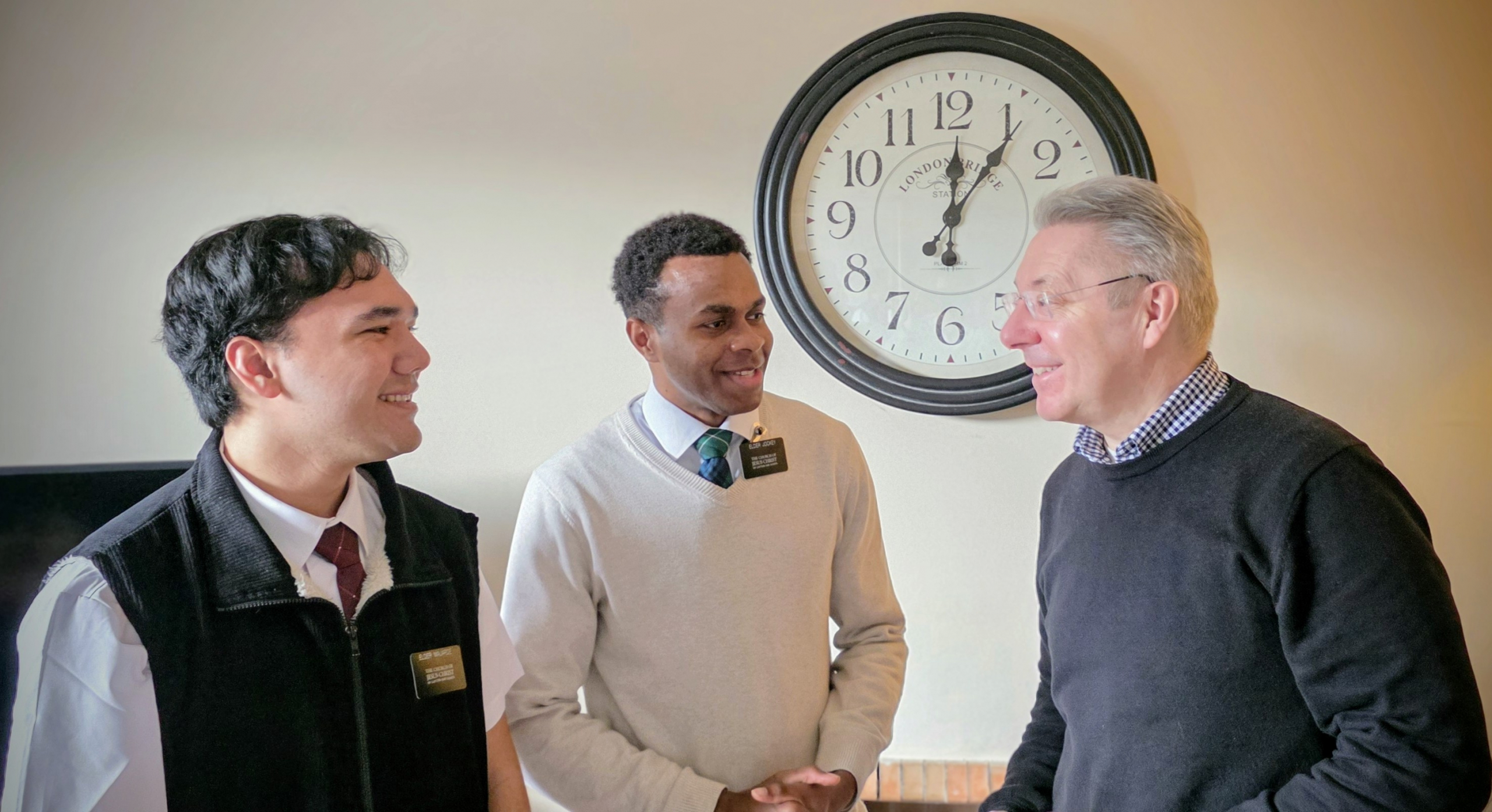
Every week, along with one or two others, I sit in a meeting to coordinate our missionary efforts in Dunfermline.
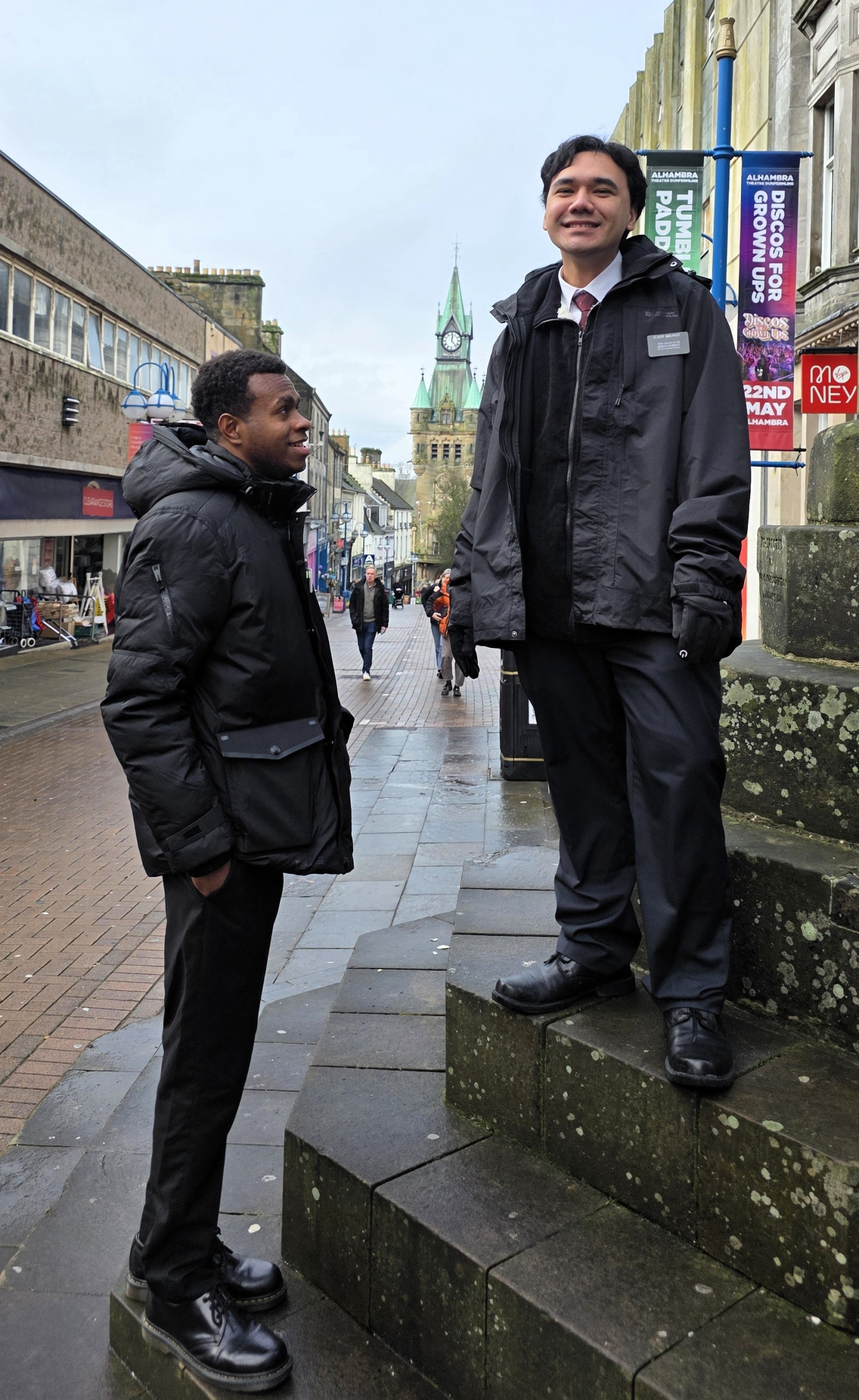
Two participants are our current missionary Elders Billy Jơckey and Angel Malarde, from the Pacific Islands of Vanuatu and Tahiti.
It’s funny that they are here together in a rather chilly Scottish winter!
Something happened this week, that made me think about them and the word “Elder”, in a slightly different way.
While facilitating a leadership programme, a behavioural change model was referenced by my colleague: Child, Adolescent, Adult, and Elder. Each state carries certain characteristics, depending on the situation.
We discussed the “Elder” state, which is typically wisdom-based, usually marked by perspective, steadiness, and a longer view of life.
As my fellow facilitator waxed lyrical about the “Elder” state, my thoughts drifted elsewhere.

My Understanding

I found myself thinking about the many missionary “Elders” I’ve known, hundreds, perhaps even thousands.
My lived experience of the word “Elder” was rather different from what was being described in that moment.
I don’t mean that unkindly, it’s simply my observation.
What struck me wasn’t that the model was wrong at all, rather it was the word “Elder” was being used in a very different way to how I’ve come to understand it through my lifetime.
In The Church of Jesus Christ of Latter-day Saints, Elder isn’t a developmental description, it’s an ordained office in the Melchizedek Priesthood.
We don’t wait until a young man has accumulated wisdom, perspective, or life experience and then say, now you qualify to be an Elder.
We do the opposite. We ordain first.
Responsibility is placed on young shoulders, and we trust that growth will follow.
Over the years, I’ve seen that growth happen time and time again.
Some of the youngest missionaries I’ve known have shown moments of remarkable wisdom, humility, and quiet maturity, often surprising themselves as much as anyone else – including me!
In essence they are becoming elders, long before they reach the age that the world associates with the term itself.
Reach out to them and find out for yourself!
What would it look like for you to live a little more “elder-like” today, regardless of your age?