The Pillow Principle
At the start of a recent Lead the Way programme at Aviva in Perth, my co-facilitator, Sophie and I ran our usual check-in.
Nothing too complicated. Just a moment to hear where people were, how they were arriving, and what they were carrying into the room.
We figured out our earliest riser and one participant, Miriam Lacey, shared that she had been up since around 2.00am.
Not 2.00am in Perth, but 2.00am in Galway, Ireland.
She had made the long journey arriving in Perth ready to learn and was still giving her attention and energy to the day. By late afternoon, however, it was becoming clear that the early start was catching up with her – and to be fair, a few others too.
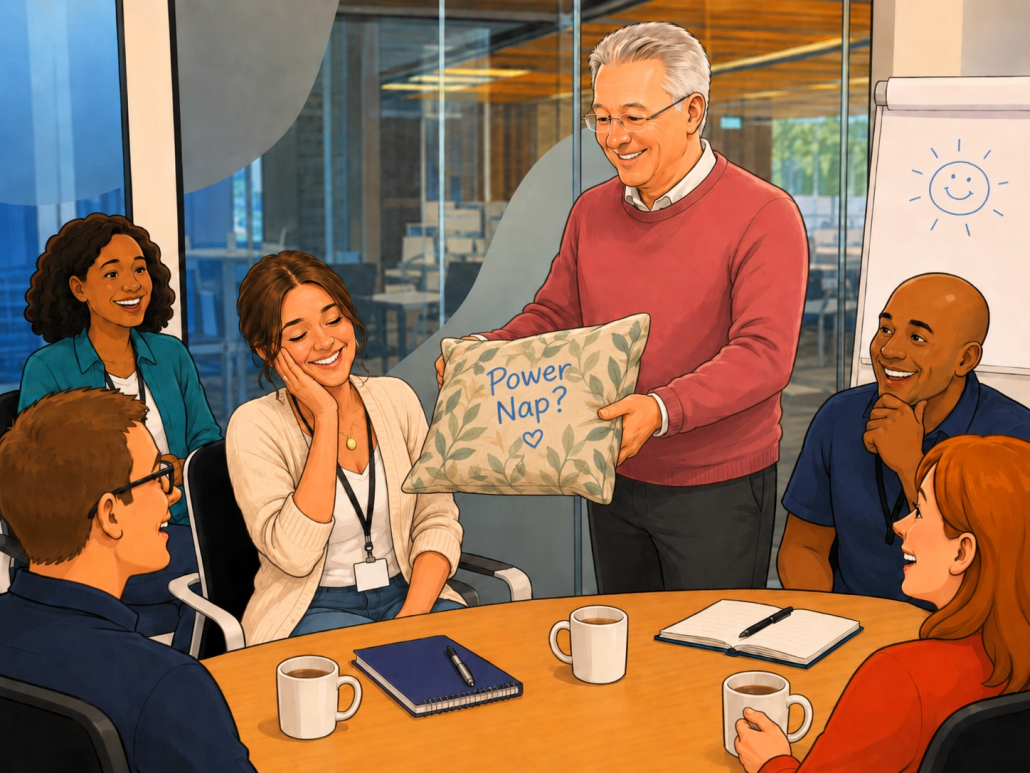
So, during a break, and mostly for a bit of fun, I went off and found her a pillow.
It got a laugh.
But it also got me thinking.
Sometimes leadership is not a grand gesture. It is not always the big speech, the strategic decision, or the perfectly crafted framework.
Sometimes leadership is simply noticing.
Noticing who has gone quiet.
Noticing who is carrying more than they said.
Noticing who is still showing up, even when their energy is running low.
And then doing something about it by showing a little empathy.
The pillow didn’t remove Miriam’s tiredness, or shorten her journey from Galway, or magically restore a full night’s sleep.
But it did say, “I see you.”
And sometimes that is the most human leadership message we can offer.
In organisations, we can become so focused on performance, outputs, pace, and productivity that we forget people are human beings, not machines. Our participants arrive with journeys behind them. Early mornings. Family pressures. Full diaries. Quiet worries. Tired minds. Heavy loads.
Leadership asks us to pay attention to the whole person, not just the role they are performing.
Yes, we still need accountability, standards, contribution, participation, and delivery.
But care and performance are not opposites.
In fact, people often give more of themselves when they know they are seen, understood, and supported.
The pillow principle may not be a leadership model, but it did cushion the point. 😊
Before we try to challenge, coach, or develop people, we may first need to notice them.
Because sometimes the smallest act of care can create the safest space to learn.
And sometimes leadership looks like a pillow placed quietly beside someone who got up at 2.00am in Galway and still chose to show up.
What small act of care could help someone feel seen this week?