Tag Archive for: facilitation

Small Moments, Big Shifts

Its been nearly two months since I stepped into my new leadership facilitation role with Aviva.
I’ve been busy learning lots about new programmes and perhaps most meaningfully, seeing the power of thinking partnerships.
One of my favourite moments in many of our recent Lead the Way workshops comes during a simple but powerful “buddy coaching” conversation.
There are four different variations of the programme, depending upon seniority level.
During each programme, individuals are frequently randomly paired together.
It’s there, that the coaching conversations begin.
One person reflecting, the other listening deeply and asking thoughtful questions.
We encourage them to be curious.
Two people, fully present, exploring what it means to grow.
On the surface, it seems like a short exercise.
However, I’ve noticed that it only takes a few intentional minutes with a learning buddy like this, to unlock something deeper, a fresh idea or perhaps a new direction for them to consider.

Sitting and Walking

Buddy coaching isn’t simply about sitting opposite each other at a table, some of the best conversations and discoveries are made whilst out for a walk together.
Changing the environment can really help each of us change how we look at things.
“Walking is man’s best medicine.” – Hippocrates
In their conversations, leaders ask each other:
• How would you describe yourself as a leader right now?
• What assumptions do you carry about leadership?
• What would ‘better’ look like for you?
Every time we run this exercise, there is a noticeable, yet subtle shift in the energy in the room, from quiet reflection to rich dialogue.
These short listening and questioning exercises help people slow down and connect.
Interestingly, another upside is they think more intentionally about how they lead and respond to change.
Sometimes the most profound learning moments don’t come from slides or theories, but from being truly heard by another person.
A simple reminder that great leadership often starts with great listening.
When was the last time you truly listened, not to respond, but to understand?

What’s in a Name?

As participants arrived in the room, one by one, they’re given their name tags.
At the same time, they tick their names off the participant list and registration is complete.
A few minutes later during our check in, everyone introduces themselves to the group.
But there’s one challenge that never seems to get any easier for me, even after years of practice… names!
Currently, every few days, I find myself faced with a fresh set of twenty to thirty or so new names to learn.
It’s no small task.
I’m not exactly sure why, but some are easy to remember, others take a few tries, and occasionally I’ll mix up two people completely, especially when there’s a Mark, a Matt, and a Martin in the same room!
Yesterday, the tables turned.
A couple of participants started calling me by the wrong name and not just once!
I could tell they felt a bit embarrassed when they realised, so, in the spirit of fun, I decided to join in.
When one of them said, “Thanks, Darren,” I smiled and replied, “No problem, Martin.” (His name was definitely not Martin.)
Cue a big smile and some laughter.
It broke the tension instantly.
The moment became fun and light-hearted.
Later, as we reflected on the day, I realised something simple yet powerful: learning names is an act of leadership.
It’s about presence.
It’s about seeing people.
When we take the time to remember someone’s name, we’re telling them, “You matter. You’re worth remembering.”
Getting it wrong occasionally?
That’s just part of the journey.
What matters is how we recover, with grace, humour, and a wee bit of warmth.
So, to all the participants out there.
Could you help us facilitator’s out?
If you spot us in an office somewhere, to ease the triggering of the mental panic, please say hello and quickly remind us of your name – just in case!
Leadership, at its best, is all about connection, and sometimes, connection begins with something as small as a name.
What other “small” leadership habits have a big impact on connection and belonging?
p.s. – maybe some bigger name tags may help too! 😅

Creating Space to Learn

Its been a quick week.

On Monday, I arrived at our venue a couple of hours before the start of the latest leadership session, I was just observing after all, but my fellow facilitators had been there for a good wee while longer!

Arriving early as a learning facilitator, is critical.

The magic however of a great learning experience doesn’t begin when the first participant walks into the room, it starts days, weeks and even months, before.

Long before a single chair is straightened or a workbook is placed on the table, facilitators are already deep in preparation.

For this programme, the preparation began in partnership, working closely with Korn Ferry Management Consultants to shape the design, alongside Aviva’s learning consultants to refine the flow and feel of the sessions.

From there came hours of reviewing materials, crafting thoughtful questions, building stories, and attending to the small details that help people connect and learn together.

Then of course there is hours of work done by our events team, who have been organising venues, coursebooks, materials, travel, meals, and most importantly of all – delegates!

This week our facilitators travelled from far and wide, bringing not only their suitcases but their energy, insights, and passion for helping others grow.

Arriving early to set up the space, check the slides, arrange materials, and make sure every table feels ready for learning, it’s all part of facilitation life.

Because when the first delegate walks in, everything should quietly say, you matter, and we’re ready for you.

Facilitation isn’t just about delivery.

It’s about intention. Preparation. Presence.

It’s about creating the conditions where learning can truly come alive.

What does great preparation look like in your world?

A new chapter

I’m happy to share that I’m starting a new position as Leadership Development Facilitator at Aviva!
Day one (yesterday) was all about collecting my new IT kit, getting set up, and (most importantly!) receiving a very warm virtual welcome from my new colleagues.
I’m really looking forward to collaborating on impactful leadership development programmes over the coming months with them all in Perth.
And yes… the thoughtful wee welcome biscuit that arrived in the post was the perfect finishing touch! It was much appreciated and enjoyed! 🍪⭐
I’ll still be doing a little bit of coaching and leadership work through my own company, plus all the other voluntary work including the FORB Foundation.
Here’s to learning, growing and making a difference together.

A Ball of String

Recently I was asked, “As a facilitator, what are your favourite learning tools in your backpack?”
I smiled…
There are many “essentials” that I carry in my backpack when I facilitate a workshop.
– Pens, markers (sharpies or neuland refillables), dry board markers, paper, post it notes.
– CCS Cards, Organisation Cards and other cards to write on
– My laptop, a pointer/clicker, extra batteries, an external mouse and a thumb drive.
– Masking tape.
– Power adaptors
– Rubber bands and Paper clips
And last but not least, my very favourite, it goes everywhere, my 𝒃𝒂𝒍𝒍 𝒐𝒇 𝒔𝒕𝒓𝒊𝒏𝒈!
It’s a short list but these few supplies have gotten me out of a lot of jams, consistently bring energy to the room, and help me to create memorable moments in any learning session.
So why a ball of string?
A simple ball of string is often underestimated, but it is a highly effective tool in facilitation.
Its versatility makes it a powerful symbol and practical tool for measuring and demonstrating different behaviours and concepts in various workshops.
Here are 2 simple examples of how I’ve used it recently…

Example 1

As a measurement tool, by using it as a line on the floor and asking participants to gauge their thoughts and feelings about something.
For example, I explain that one end of the line is “Strongly Agree,” the opposite end is “Strongly Disagree,” and the middle represents a neutral stance.
The activity always involves making decisions about how much they agree or disagree with statements or questions that I ask.
On every occasion, I invite participants to position themselves on the line to indicate their view, leading to some fascinating discussion and varied opinions.
Another one I use string for is to help people understand the importance of connection and communication within a team.

Example 2

When one person talks or shares an idea, they hold onto the string and toss the ball to someone else.
As the string weaves across the group, it creates a visual web of connections, symbolising how each person’s input influences the others.
It can be a powerful illustration of interdependency in any team, and how communication flows through and binds a team together.
A ball of string is more than a basic tool as it can symbolise and practically demonstrate essential leadership behaviours.
What’s in your backpack?

“How did you get into coaching then…?”

Recently I have been asked several times…”So Daryl, just how did you get into coaching and mentoring”?
Here’s my story.
In 2001, I was busy with a young family, an active sales career and a challenging, but enjoyable church assignment as a Bishop in The Church of Jesus Christ of Latter-day Saints. All three combined gave me an incredible insight into working with people of all ages in a wide range of circumstances.
My sales career was progressing well and I very much enjoyed talking to people and building trusting relationships. That said, I also enjoyed the many counselling sessions I’d have with church members. In both situations, I was being called upon regularly to give presentations and lead many training sessions on a range of leadership topics. Subsequently, I determined to enrol at night school at my local college embarking upon a CIPD – Certificate in Training Practice. It was one evening per week for several months. I loved it! Below is my graduation photo – wow I was young!
As the years have rolled by, my focus shifted towards coaching, facilitation and training, gaining further Diploma’s and qualifications along the way. I then set up my own consultancy back in 2014. I am so grateful too for my wife Monic’s constant words of encouragement and support throughout – that has always made a huge difference.
My advice, get all the education you can! Get at it, work at it, study hard and go for it!

Don’t Give Up!

Tuesday morning my brain was completely fried due to the complexity of a piece of virtual #facilitation.

“My, oh my, this is tortuous!” I thought.

Then came feelings of self doubt, fear, anxiety and a resignation that I simply couldn’t get my head around what was expected. I became a little grumpy….(well maybe a big bit!)

Consulting with a few other virtual facilitators, they felt exactly the same…(even more scary, and now even more grumpy too!)

I persevered.
Then I persevered a little more.
And still even more.

With a little more effort, a little more #patience, a little more #persistence and some practice & experimentation thrown in too for good measure, eventually…it started to make a little more sense.

By Wednesday afternoon, I’d cracked it! I was overcome with a huge sense of relief and started dancing around the living room.

This morning, as I get back online for the last rounds of the virtual facilitation, I am actually looking forward (and just a little excited too) about the day ahead. And I’ll have a bit of fun too!

Being taken of your comfort zone into your stretch zone, can be very painful at times – I can testify of that! Yet, strangely it also brings a great sense of accomplishment, once you achieve the goal.

Have you been stretched recently?

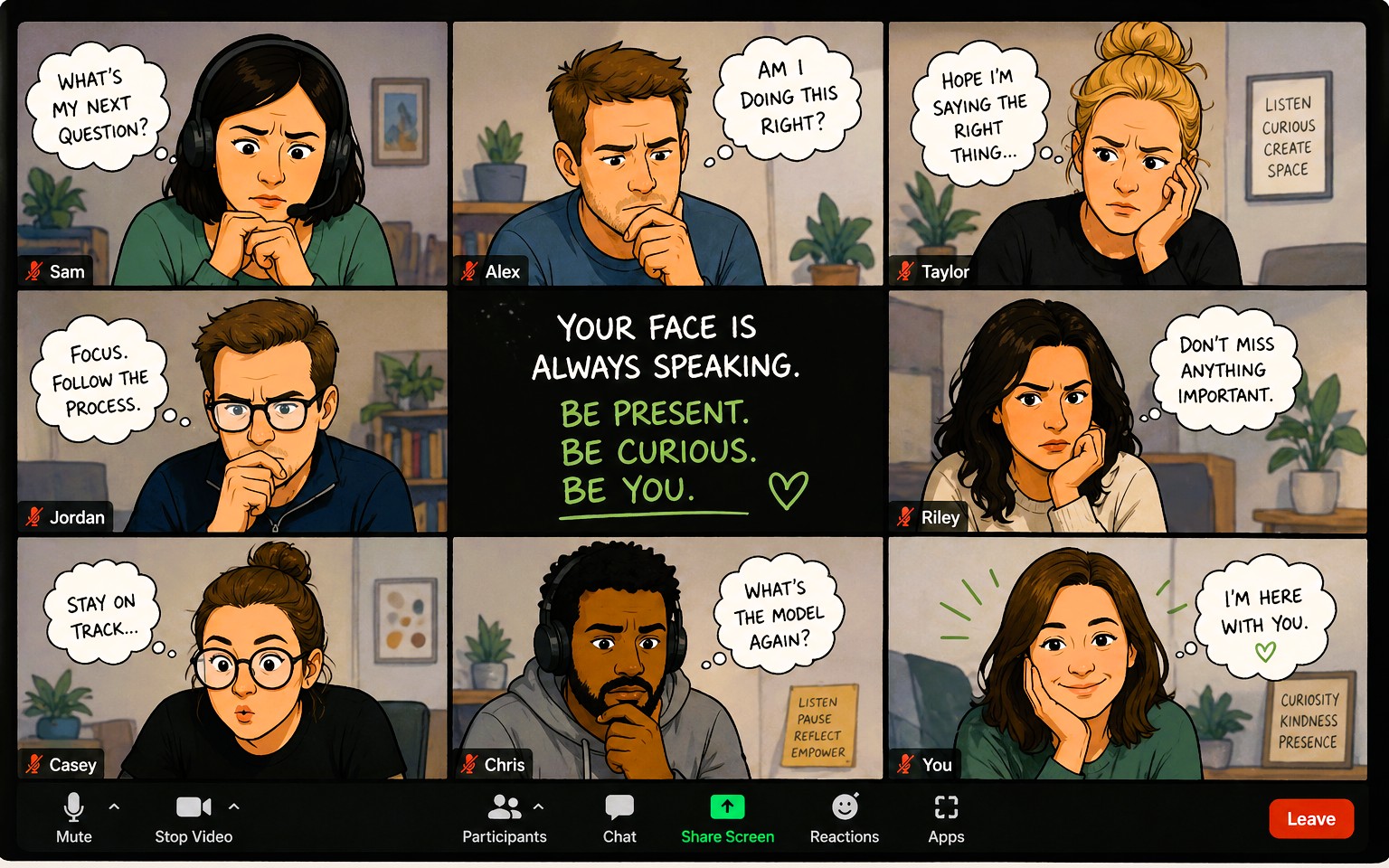
Zoom Fatigue…

Are you Zoomed-out?

It has been an extremely heavy week with virtual facilitation sessions galore for me. Zoom fatigue is now a real thing! Don’t believe me? Just google it and see. It certainly struck home this week, for sure.

One thing I have noticed as a virtual facilitator is that every session demands your FULL, undivided attention for 2, sometimes even 3 hours straight. And not only once, but perhaps 2 or 3 times a day. As I have come to recognise and experience this week, I am mentally and physically exhausted. Sleep has come easy.

My key personal learning takeaways this week….

Build in some downtime for a break, a walk, to stretch your legs, get some fresh air and constantly rehydrating with fresh water has become absolutely essential.

I am finding that downtime, some kind of digital detox away from computers, phones, tablets is now a critical part of my regular daily routine – escaping the noise of the Zoom world is now an everyday imperative.

What are your top tips to combat Zoom fatigue!?