Tag Archive for: adaptation

Roadshow Surprise

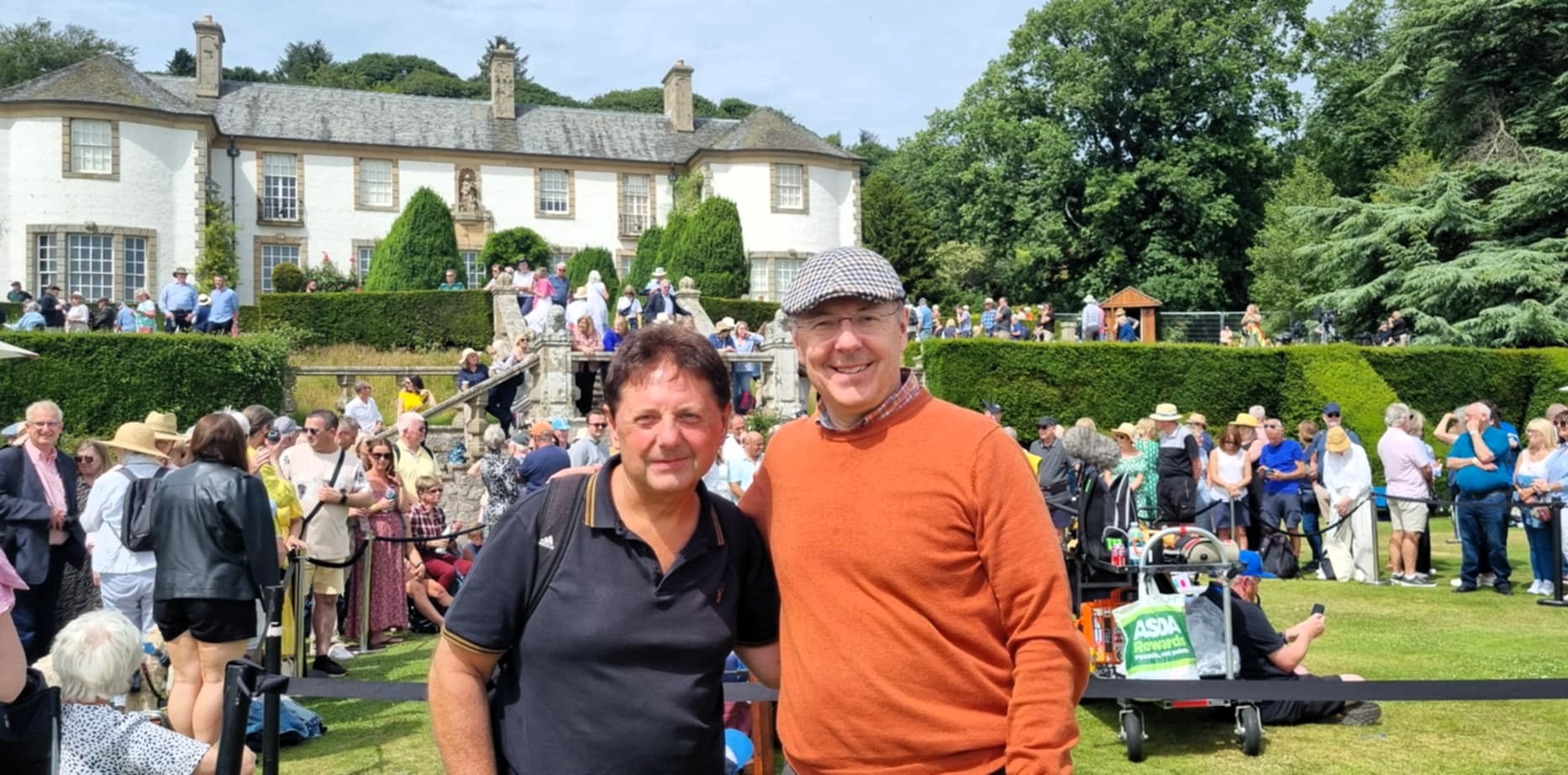
My brother and I had a great day recently at the BBC Antiques Roadshow at the Hill of Tarvit Mansion & Garden in Fife.
It was beautiful sunny day, a great location and there was a wee bit of telly magic in the air.
Paul had brought along a few items to be valued, and after checking-in, we were off queuing with our two tickets – one for jewellery, one for miscellaneous.
The line for jewellery was already fairly long, but everyone was happy, and we had some lovely chats with folk while we waited.
Then the fun started.

Everything Changed

We got to Siobhan (one of the experts), and Paul started sharing some items.
A few estimates were given, all very nice… then he pulled out something else and her face lit up.
She just said, “I think we need to get these filmed,” we looked at each other with big smiles!
“Do not doubt, just believe” – we thought.
From there, it was like entering a different world.
We were moved into another waiting area (and then another!), then finally (after a fair bit of waiting) – filming time.
Paul was great.
When the final valuation came through, I nearly had to pick him up off the grass.
Let’s just say… it was worth the wait! 😊
We never did make it to the miscellaneous line; our time had run out!

Effortless

We were both impressed how well the whole event was run and organised.
Yes, we had a bit of waiting to do, but smooth check-ins, clear signage, friendly staff, and when something unusual cropped up, the process adapted – fast, all made for a hugely enjoyable day out.
I noticed too there was no fuss and no drama throughout the day, just a well-oiled team who knew their roles and trusted each other to get on with it.
That’s how good events feel effortless.
So, whether you’re managing antiques roadshow or running a business, there’s something to be said for:
• Having a clear plan.
• Empowering your team to be in the moment.
• And always being ready to shift gears like Siobhan when something kind of special turns up.
Paul and I had a great day out and fingers crossed we make the cut when it airs!
How agile are you or your team to pivot, when opportunity shows up?
Built Right, Still Wrong…

At home these last few weeks, Monic has been on another mission, painting and decorating.
 
At times the house has been upside down and, on a few occasions, I’ve been enlisted to help.
 
It may have been to move a bed, lift a rug, order something online, build some flat pack furniture, pick up something from a shop etc.
 
Monic’s work ethic is amazing and when she gets started, you simply need to get out of the way.
 
It got me thinking about a few things – especially when it came to flat pack self-assembly furniture this week.
 
I ordered the items online, picked them up from the store and duly started to put the bedside cabinet together.
 
It wasn’t too difficult and within an hour the first was completed.
 
Having built one, the second was easier and within half an hour, the last thing I needed to do was put the drawer in.
 
But alas, for some reason, it wouldn’t fit!?
 
Cue that familiar DIY moment: denial, frustration, blame.
 
Was it me? Did I mess something up?
 
Stumped, I took a closer look.
 
The drawer rail pre-installed by the manufacturer was the wrong one.
 
I couldn’t do a thing.
 
I called on Monic to check it wasn’t just me seeing something wrongly…
 
She confirmed that no tool could fix that.

The Life Lesson

 
And that’s when it clicked, this was a real-world lesson in control.
 
– I had 𝒕𝒐𝒕𝒂𝒍 control when I laid out the parts and followed the instructions.
– I had 𝒔𝒐𝒎𝒆 control when I checked my work and asked for a second opinion.
– But with the faulty rail? I had 𝒛𝒆𝒓𝒐 control. All I could do was adapt. Accept. Return it and reorder.
 
On reflection – I followed the instruction manual with exactness, step by step.
 
But the part was wrong from the start.
 
There was nothing I could do to fix it.
 
Sometimes, even when you do everything right, things still won’t work—because the problem was built in from the start.
 
The real test is how you respond when the plan fails.
 
Are you solving problems—or just following instructions?

Making Metamorphosis Stick

Graduating from university many years ago, literally changed the direction of my life.
I recall attending one of a myriad of careers fairs, where numerous companies visited the university and talked about job opportunities.
One company in particular “Metamorphose” sourced and developed graduates for sales positions and after enduring an intensive selection process, I was offered my first graduate sales role with a major company.
Over the course of the next year Metamorphose were set to fine tune my sales skills through a series of training seminars and inspirational leadership events.
During each session and the subsequent year-long follow up, the big idea was to transfer some of the greatest sales skills and ideas into our daily conduct and routines.
To make it “sticky” enough to make a real difference in our sales abilities, our effectiveness and ultimately the results that we achieved.
In essence it was important for Metamorphose that their training manifested itself in the personality, conduct and performance of each graduate student.
The training certainly was first class and to this day, I still use their materials and powerful techniques.
Sadly however, along the way, there were many who failed.

Adaptation

In life, I’ve discovered that there are many who can hear a great message and not be deeply stirred – we are all different after all.
Yet others, have the ability to take ideas successfully through the early stages of their metamorphosis to where they become ingrained habits that drive long-term success.
The difference often lies in commitment, mindset, and the willingness to apply what is learned consistently.
I saw first-hand how some graduates thrived, seizing every opportunity to refine their skills, while others struggled to implement the lessons.
The most successful individuals were those who embraced continuous learning, adapted to challenges, and stayed persistent even when results were slow to appear.
An effective way to make learning “sticky” is through constant practice, by applying new skills in real-world scenarios until they become second nature.
Another is by repetition, revisiting key concepts over and over to reinforce retention.
For me, coaching and mentoring others has proven to be the best “sticky” method of all.
Looking back, I realise how much of that early training has shaped my approach to business and personal growth today.
What’s one lesson from your early career that has stayed with you?

And we’re off! (again)

The 𝐨𝐧𝐥𝐲 constant in life is 𝒄𝒉𝒂𝒏𝒈𝒆.
Fasten your seatbelts everyone!!!
Change in the mission field accelerates at an unprecedented speed.
Yet, our six-week mission transfer cycle ensures that the pace of change is also predictable.
While this is overwhelming for some, it isn’t going to stop anytime soon!
If you are serving as a missionary in any one of the 416 missions around the world, you’ll need to keep up!
The work of salvation is hastening even faster, there is an increased urgency and speeding up of the work, is an absolute, it is a given!
So how do you keep up?
Maintaining a regular constant regime of learning, through daily routines can really help.
In our mission, like others, there is a strong focus on 𝐥𝐞𝐚𝐫𝐧𝐢𝐧𝐠.
We decelerate on a few occasions too, in order to accelerate once more.
Slowing down in our Mission Leadership Council, Zone Councils, District Councils, Zone Conferences, weekly huddle calls and 1-1 personal coaching sessions with every missionary, allows each of us to catch our breath just long enough, communicate, have some deep dialogue, get aligned, then set the right attentions and intentions for the remainder of the transfer.
I have experienced that our environment of constant change is as natural as breathing.
But, like anything else, it takes time to adjust and find your rhythm.
Weaving agility, flexibility, adaptation, and resilience into our personal DNA help us feel comfortable.
Ultimately, change happens through people.
I have learned that if you want to keep pace with change and tackle future changes, then the 𝐤𝐞𝐲 is to 𝒉𝒆𝒍𝒑 𝒑𝒆𝒐𝒑𝒍𝒆 𝒕𝒐 𝒄𝒉𝒂𝒏𝒈𝒆 𝒕𝒉𝒆𝒎𝒔𝒆𝒍𝒗𝒆𝒔.
How do you manage to keep up with change?